
Quick Answer: Websites operating in 2026 face a fundamentally redesigned compliance landscape. At least 20 U.S. states now have active or newly enforced privacy laws, the EU's regulatory framework continues to expand, and regulators across Asia-Pacific and Latin America have introduced new obligations. Adapting your website for 2026 means embedding privacy into your technical architecture, consent interfaces, and data handling workflows, not just updating a policy document.
Key Takeaways
- Privacy compliance in 2026 has shifted from a documentation exercise to an engineering and product design requirement
- New or amended privacy laws are active across 20+ U.S. states, with Indiana, Kentucky, and Rhode Island entering enforcement in 2026 [8]
- GDPR remains the global benchmark, but enforcement now scrutinizes consent interface design, not just data processing agreements
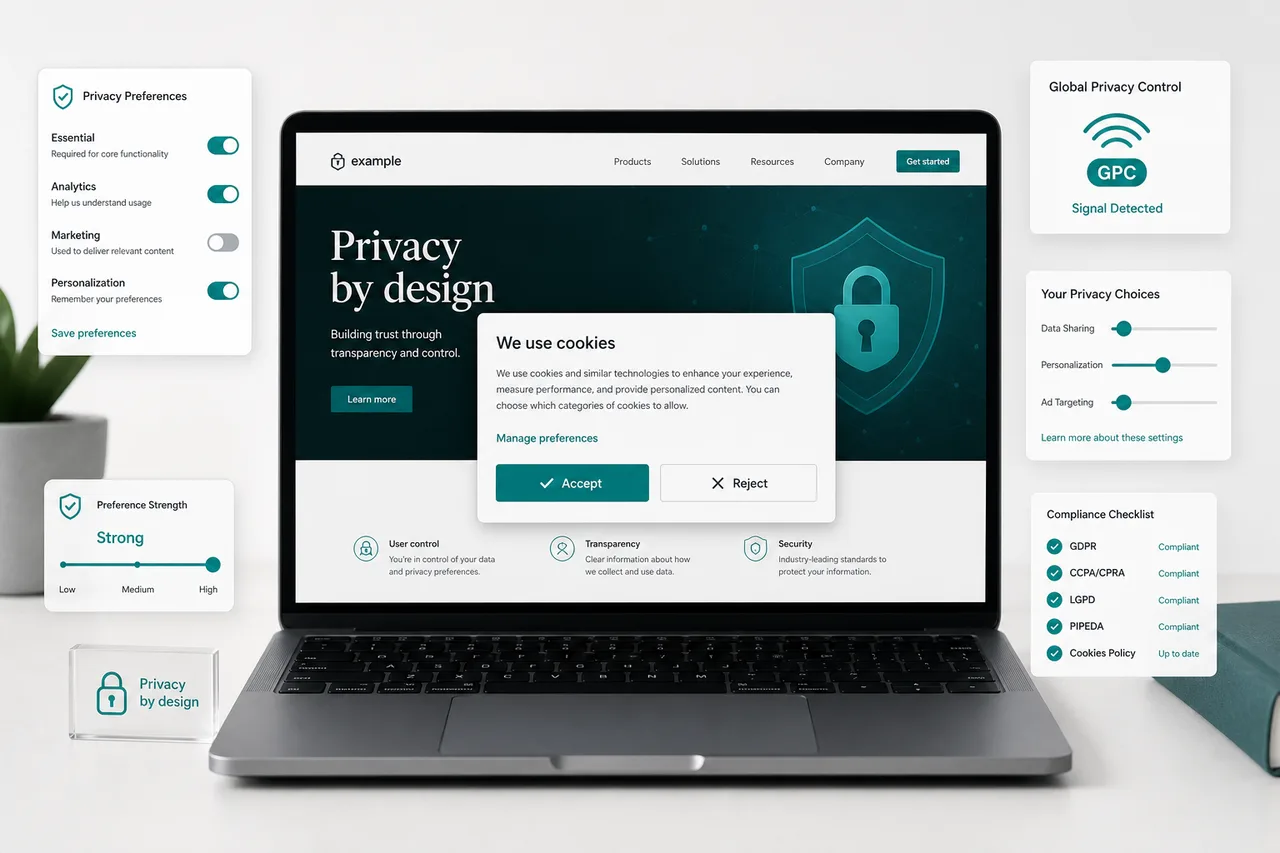
- The "Reject All" button must be as prominent as "Accept All" under current regulatory expectations [9]
- Global Privacy Control (GPC) signals must be recognized and honored automatically by compliant websites [8]
- Connecticut now classifies neural data as sensitive personal information as of July 1, 2026 [8]
- Small businesses are not exempt from most state-level privacy laws once they meet volume or revenue thresholds
- A consent management platform (CMP) is now a practical necessity, not an optional enhancement
- Non-compliance penalties can reach into the millions; enforcement actions are accelerating globally [9]
- Privacy policy updates alone are insufficient; technical controls, consent architecture, and data subject rights workflows all require review
What Are the Main Privacy Laws You Need to Follow in 2026
The short answer: it depends on where your users are located, not just where your business is registered. In 2026, any website collecting personal data from users in the EU, UK, California, or dozens of other jurisdictions must comply with the applicable law for each user's location.
The most significant frameworks affecting websites globally include:
| Jurisdiction | Law/Framework | Key 2026 Development |
|---|---|---|
| European Union | GDPR + EU Data Act | Design-level obligations; interoperability requirements [5] |
| United Kingdom | UK GDPR + DPDI Act | Digital verification services regulation [5] |
| California | CCPA/CPRA | Cybersecurity audit + expanded risk assessments [8] |
| Indiana, Kentucky, Rhode Island | State CPAs | Enforcement begins January 1 / July 1, 2026 [8] |
| Vietnam | PDPL | New comprehensive personal data law [5] |
| Australia | Privacy Act amendments | Automated decision-making transparency rules [5] |
Beyond these, over 50 jurisdictions globally now maintain active data privacy frameworks [7]. Websites with international traffic should conduct a jurisdiction mapping exercise to identify which laws apply to their user base.
How Is GDPR Changing in 2026
GDPR itself has not been fundamentally rewritten, but its enforcement context has shifted considerably. The EU Data Act, which layers design obligations onto GDPR's existing requirements, now compels organizations to build privacy into product architecture rather than layering it on afterward [5].
Practically, this means:
- Consent capture must be technically verifiable, not just policy-stated
- Data portability must be technically enabled, with structured export formats
- Interoperability obligations require that consent preferences can travel across systems
- Regulators are examining whether consent interfaces use dark patterns, with fines issued for asymmetric button designs [9]
The 2026 enforcement environment treats a poorly designed cookie banner as a compliance failure, not a cosmetic issue.
What Is the Difference Between GDPR and CCPA Compliance
GDPR (EU) and CCPA/CPRA (California) share the same philosophical goal but differ in scope, legal basis, and technical requirements. Websites serving both EU and California users must satisfy both frameworks simultaneously.
Key differences:
- Legal basis: GDPR requires a lawful basis for every processing activity (consent, legitimate interest, contract, etc.). CCPA operates on an opt-out model for data sales and sharing, not an opt-in requirement for all processing
- Rights scope: GDPR grants broader rights including rectification and restriction of processing. CCPA adds a right to correct and a right to limit use of sensitive personal information
- Thresholds: CCPA applies to businesses meeting revenue or data volume thresholds; GDPR applies to any organization processing EU residents' data regardless of size
- Enforcement: GDPR enforcement is handled by Data Protection Authorities; CCPA enforcement falls to the California Privacy Protection Agency (CPPA)
A website cannot use a single consent banner design to satisfy both frameworks without careful architecture. The opt-in requirement under GDPR for tracking cookies conflicts with CCPA's opt-out model, requiring conditional logic based on user location.
Do You Need to Update Your Privacy Policy for 2026
Yes, and a policy update alone is not sufficient. Privacy policies must accurately reflect current data practices, list all third-party processors, describe automated decision-making where applicable, and explain how users can exercise their rights under each applicable law [8].
Beyond the document itself, websites need to verify that:
- The rights request mechanism (data access, deletion, portability) is functional and meets response time requirements
- Sensitive data categories (including neural data in Connecticut as of July 1, 2026) are identified and handled correctly [8]
- Third-party data sharing disclosures are current and accurate
- The policy is accessible from every page, not buried in a footer link that fails on mobile
Which Privacy Regulations Will Affect Your Business in 2026 and How to Know If Your Site Needs Updates
A website needs compliance updates if it collects any personal data (names, emails, IP addresses, cookies, behavioral data) from users in jurisdictions with active privacy laws. Given that IP addresses alone constitute personal data under GDPR, virtually every website with international traffic qualifies.
Use this decision framework:
- If you use Google Analytics, Meta Pixel, or any behavioral tracking: you need a compliant consent mechanism
- If you collect email addresses: you need a lawful basis and a clear privacy notice
- If you operate in or serve users from California, the EU, UK, or any of the 20+ active U.S. state jurisdictions: you need jurisdiction-specific rights workflows
- If you use AI-driven personalization or recommendation systems: you may have automated decision-making disclosure obligations under Australian and EU rules [5]
What Happens If Your Site Is Not Compliant With Privacy Laws by 2026
Enforcement is accelerating. TrustArc's 2026 enforcement analysis documents a surge in regulatory actions, with fines targeting not just large enterprises but mid-market companies and SaaS platforms [9]. Penalties under GDPR can reach 4% of global annual turnover or 20 million euros, whichever is higher. U.S. state penalties vary but commonly range from $2,500 to $7,500 per intentional violation.
Beyond direct fines, non-compliant sites face:
- Regulatory investigations triggered by user complaints
- Mandatory audits in California for certain data categories [8]
- Reputational damage from public enforcement decisions
- Potential civil liability under state laws that include private rights of action
The risk calculus has changed: the cost of compliance is now consistently lower than the cost of a single enforcement action for most businesses.
How Much Does It Cost to Make a Website Privacy Compliant
Costs vary significantly based on website complexity, current state of compliance, and the jurisdictions involved. A reasonable cost breakdown for a mid-sized website in 2026:
- Consent management platform: Free to several hundred dollars per month depending on traffic volume and features
- Privacy policy drafting or legal review: $500 to $5,000+ depending on jurisdiction complexity
- Technical implementation (developer time): 10 to 40 hours for a standard CMS-based site
- Ongoing compliance monitoring: $100 to $500/month for automated scanning tools
For enterprises with complex data ecosystems, costs scale considerably. The shift to privacy-as-infrastructure means compliance is increasingly a product and engineering budget line, not just a legal one [5].
What Is the Easiest Way to Implement Privacy Compliance on Your Site
The most practical starting point is deploying a consent management platform (CMP) that handles cookie consent, preference storage, GPC signal recognition, and consent logging automatically. A CMP removes the need to hand-code consent logic and ensures that consent architecture keeps pace with regulatory changes.
Biscotti CMP is one such platform designed to handle the technical requirements of modern consent management, including GPC signal recognition, granular consent by purpose, and equal-prominence opt-out mechanisms that regulators now expect [8][9].
Beyond a CMP, the implementation checklist includes:
- Audit all third-party scripts and cookies currently loading on your site
- Categorize each cookie by purpose (strictly necessary, analytics, marketing, preferences)
- Block non-essential scripts from loading before consent is granted
- Implement a data subject rights request form with documented response workflows
- Update your privacy policy to reflect current practices and applicable laws
- Test your consent interface for dark patterns (asymmetric buttons, confusing language, pre-ticked boxes)
Do Small Businesses Have Different Privacy Requirements Than Large Companies
Small businesses are not categorically exempt, but many laws include size-based thresholds. CCPA, for example, applies to businesses with annual gross revenues above $25 million, or those that buy, sell, or share personal information of 100,000 or more consumers annually, or derive 50% or more of annual revenues from selling personal information.
GDPR, by contrast, applies to any organization processing EU personal data regardless of size, though it does exempt very small organizations from some record-keeping requirements.
Practical guidance for small businesses:
- If your site uses Google Analytics or any ad retargeting, GDPR consent requirements apply regardless of company size
- If you operate a U.S.-based e-commerce site with significant California traffic, verify whether you meet CCPA thresholds
- Even below legal thresholds, a basic privacy policy and functional opt-out mechanism reduce regulatory risk and build user trust
Common Mistakes People Make With Privacy Compliance
These are the errors that generate the most enforcement attention in 2026:
- Asymmetric consent buttons: Making "Accept All" visually dominant while burying "Reject All" is now treated as a dark pattern and a compliance failure [9]
- Consent without blocking: Displaying a consent banner while third-party scripts load in the background before any choice is made
- Ignoring GPC signals: Failing to recognize browser-level Global Privacy Control signals as valid opt-out requests [8]
- Outdated vendor lists: Privacy policies listing processors that are no longer used, or omitting new ones
- No documented retention policy: Collecting data without defined retention periods violates GDPR's storage limitation principle
- Treating compliance as a one-time project: Privacy obligations change as laws evolve; a 2024 setup may not satisfy 2026 requirements
How to Handle International Users From Different Countries
Websites with international traffic need geo-targeted consent logic. A user from Germany must receive GDPR-compliant opt-in consent before any tracking begins. A user from California should receive a "Do Not Sell or Share My Personal Information" notice and opt-out mechanism. A user from a jurisdiction without a comprehensive privacy law may receive a simplified notice.
This requires:
- IP-based geolocation to detect user jurisdiction
- Conditional consent banner logic that serves the appropriate version
- Separate consent records by jurisdiction
- A CMP capable of managing multiple regulatory frameworks simultaneously
The EU Data Act's interoperability requirements also mean that consent preferences should, where technically feasible, be portable across services a user interacts with [5].
FAQ
Q: Does my website need a cookie banner if I only use essential cookies? A: No. Strictly necessary cookies do not require consent under GDPR or most state laws. However, you still need a privacy notice explaining what cookies are used and why.
Q: What is a Global Privacy Control (GPC) signal? A: GPC is a browser-level signal that communicates a user's opt-out preference to websites automatically. Under California law and several other state frameworks, websites must recognize and honor GPC signals as valid opt-out requests [8].
Q: How often should I update my privacy policy? A: Review your privacy policy at least annually and whenever you add new data processors, change data practices, or when a new law affecting your users comes into effect.
Q: Can I use a free cookie consent plugin and still be compliant? A: Possibly, but free tools often lack the consent logging, GPC recognition, and granular purpose management that 2026 regulations require. Verify that any tool you use meets current technical standards before relying on it.
Q: What is "privacy by design" and does it apply to my website? A: Privacy by design means building data protection into systems from the start rather than adding it afterward. The EU Data Act and GDPR both embed this principle as a legal obligation for organizations processing personal data [5].
Q: Is a privacy policy the same as a cookie policy? A: No. A privacy policy covers all personal data collection and processing. A cookie policy specifically describes the cookies your site uses, their purpose, and how users can manage them. Many sites combine both in one document, which is acceptable provided all required information is present.
Q: What is neural data and why does it matter in 2026? A: Neural data refers to information derived from brain activity or neurological signals. Connecticut explicitly classified it as sensitive personal information as of July 1, 2026, meaning sites using advanced biometric or neuro-data technologies must apply heightened protection standards [8].
Q: How long do I have to respond to a data subject access request? A: Under GDPR, the standard response time is one calendar month, extendable by two additional months for complex requests. California's CPRA requires response within 45 days, with a 45-day extension available.
Conclusion
Adapting your website for 2026: the future of global privacy compliance is no longer a legal checkbox exercise. It is a product and engineering commitment that runs from consent interface design through data architecture, vendor management, and ongoing monitoring.
Actionable next steps for website owners and developers:
- Conduct a full cookie and data flow audit to map what is collected, by whom, and under what legal basis
- Deploy a consent management platform such as Biscotti CMP that supports GPC signals, equal-prominence opt-out, and multi-jurisdiction logic
- Update your privacy policy to reflect 2026 obligations, including new state laws and sensitive data categories
- Test your consent interface for dark patterns before regulators do it for you
- Establish a regular compliance review cycle, at minimum annually, to catch new obligations as they take effect
The organizations that treat privacy compliance as infrastructure rather than paperwork will be better positioned for enforcement scrutiny, user trust, and the regulatory environment that continues to evolve beyond 2026.
References
[2] Global Data Privacy Laws 2026 - https://www.kiteworks.com/regulatory-compliance/global-data-privacy-laws-2026/ [3] Global Privacy Watchlist - https://www.mayerbrown.com/en/insights/publications/2026/01/global-privacy-watchlist [4] Global Privacy Compliance Trends In 2026 - https://www.schellman.com/blog/privacy/global-privacy-compliance-trends-in-2026 [5] Data Privacy Ai Regulatory And Compliance Update 2026 - https://www.kasowitz.com/media/viewpoints/data-privacy-ai-regulatory-and-compliance-update-2026/ [6] The 5 Trends Shaping Global Privacy And Enforcement In 2026 - https://www.onetrust.com/blog/the-5-trends-shaping-global-privacy-and-enforcement-in-2026/ [7] International Lawyers Guide Data Privacy Laws 2026 Navigating 50 Plus Jurisdictions - https://globallawlists.org/insights/international-lawyers-guide-data-privacy-laws-2026-navigating-50-plus-jurisdictions [8] Privacy Laws 2026 - https://secureprivacy.ai/blog/privacy-laws-2026 [9] Privacy Enforcement Surging 2026 - https://trustarc.com/resource/privacy-enforcement-surging-2026/