
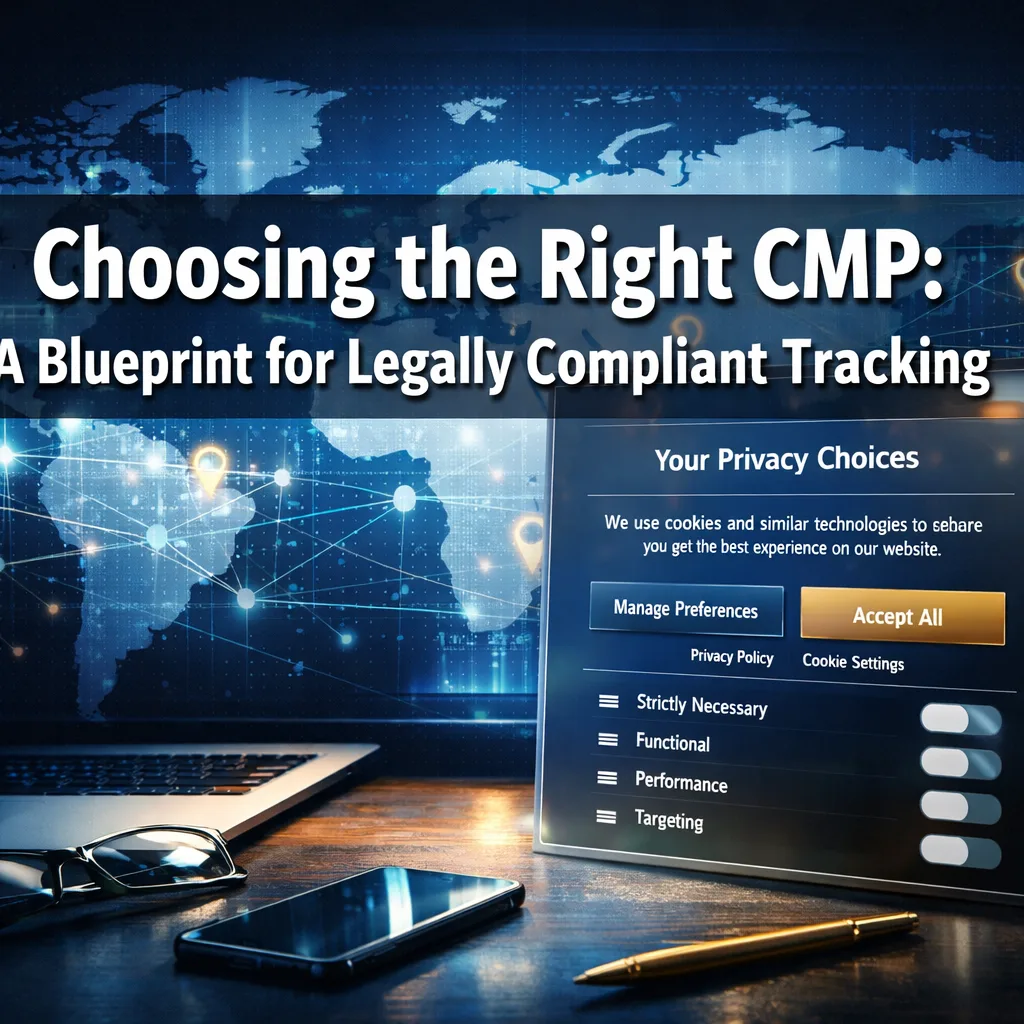
Quick Answer: A Consent Management Platform (CMP) is the technical and legal mechanism through which websites collect, store, and signal user consent for data tracking. Choosing the right CMP, a blueprint for legally compliant tracking, requires matching your regulatory obligations, tech stack, and audience geography to a platform that produces verifiable consent records, not just a visible cookie banner. In 2026, regulators across the EU, US, and beyond are demanding enforcement evidence, not cosmetic compliance.
Key Takeaways
- A CMP does more than display a cookie banner; it must capture, store, and signal consent in a format auditors and regulators can verify.
- GDPR and CCPA/CPRA require different consent models (opt-in vs. opt-out), and your CMP must handle both if you serve international audiences.
- Google's Consent Mode v2 requires a certified CMP to pass consent signals to Google Analytics and Google Ads correctly [6].
- Twelve US states now mandate Global Privacy Control (GPC) signal recognition, accelerating CMP market requirements [8].
- Not having a CMP exposes websites to regulatory fines, ad revenue loss, and broken analytics pipelines.
- CMP costs range from free tiers for small sites to enterprise contracts exceeding $10,000/year for large publishers or multi-jurisdiction deployments [4].
- The biggest implementation mistake is treating consent as a UI problem rather than a data infrastructure problem.
- Auditing your CMP means checking consent logs, signal firing order, and GPC response, not just banner appearance.
What Is a CMP and How Does It Work
A Consent Management Platform is software that intercepts data collection scripts on a website, presents users with consent choices, records those choices, and then fires or suppresses tracking tags based on the user's decision. The entire chain, from banner display to tag execution, must be logged and reproducible for compliance purposes [5].
When a user lands on a page, the CMP loads before any analytics or advertising scripts. It checks for a stored consent signal (cookie or localStorage entry). If none exists, it presents the consent UI. Once the user responds, the CMP writes a consent record and communicates that record to downstream tools via a data layer event or a standardized framework like the IAB Transparency and Consent Framework (TCF) [7].
Key components of a functioning CMP:
- Consent UI (banner, modal, or preference center)
- Consent signal storage (first-party cookie or server-side log)
- Tag blocking/firing logic (often via a tag manager integration)
- Consent record database (for audit trail)
- GPC signal listener (required in 12+ US states) [8]
The Difference Between a CMP and a DMP for Data Tracking
A CMP governs whether data can be collected; a Data Management Platform (DMP) stores and segments the data after it has been collected. These are complementary tools, not interchangeable ones.
A DMP aggregates audience data for advertising targeting. A CMP sits upstream, acting as the gatekeeper that determines which data flows into the DMP at all. Running a DMP without a properly configured CMP means the data inside it may have been collected without valid legal basis, a significant liability under GDPR Article 6.
CMP Compliance Requirements: GDPR, CCPA, and Beyond
Under GDPR, consent must be freely given, specific, informed, and unambiguous, meaning pre-ticked boxes and consent bundled with terms of service are invalid. Under CCPA/CPRA, the obligation shifts to honoring opt-out requests, including GPC signals, rather than obtaining prior opt-in [10].
Regulatory requirements by jurisdiction:
| Regulation | Model | GPC Required | Consent Record Needed |
|---|---|---|---|
| GDPR (EU) | Opt-in | No | Yes |
| CCPA/CPRA (CA) | Opt-out | Yes | Yes |
| Connecticut CTDPA | Opt-out | Yes (from July 2026) [10] | Yes |
| IAB TCF v2.2 | Opt-in (for vendors) | No | Yes |
Regulators now expect "enforcement evidence", actual consent logs, timestamped records, and proof that tags did not fire before consent was granted [5]. A banner that looks compliant but fires pixels before user interaction fails this standard.
Do You Really Need a CMP for Your Website
Yes, if your site uses any third-party tracking, analytics, advertising pixels, or behavioral profiling tools and serves users in the EU, California, or any of the 12+ US states with active privacy laws. The threshold is low: even a single Google Analytics tag or Meta Pixel triggers the requirement under GDPR if EU users are in your audience.
Small sites sometimes assume they fall below regulatory radar. That assumption is increasingly risky. Connecticut's expanded data privacy requirements effective July 1, 2026 extend obligations to smaller operators [10], and enforcement actions in Europe have targeted sites of all sizes.
You may not need a full CMP if: your site collects zero third-party data, uses only strictly necessary first-party cookies, and serves no EU or covered-state users. For everyone else, a CMP is not optional.
How Much Does a CMP Cost
CMP pricing in 2026 spans a wide range. Free or low-cost tiers typically cover small sites with basic banner configurations and limited consent log storage. Enterprise deployments with multi-domain support, server-side consent, and legal team dashboards can cost significantly more [4].
- Free tiers: Suitable for personal blogs or single-domain sites with low traffic and basic GDPR/CCPA needs.
- Mid-market ($20,$200/month): Multi-domain support, A/B testing for consent rates, tag manager integrations, basic reporting.
- Enterprise ($500,$2,000+/month): Custom legal frameworks, dedicated support, server-side consent, audit-ready reporting, API access [4].
Cost should not be the primary selection criterion. A cheap CMP that produces non-compliant consent records costs far more in regulatory exposure than a properly configured enterprise solution.
Choosing the Right CMP for International Websites
International websites face the hardest configuration challenge: different jurisdictions require different consent behaviors from the same CMP instance. The right CMP for international use must support geolocation-based rule sets, meaning it can serve an opt-in banner to EU visitors and an opt-out notice to California visitors from the same deployment.
Selection criteria for international sites:
- Geolocation detection with jurisdiction-specific consent flows
- IAB TCF v2.2 certification for EU ad tech compliance [7]
- GPC signal recognition for US state compliance [8]
- Multi-language banner support
- Consent record storage that meets GDPR data residency requirements
Biscotti CMP is built to address multi-jurisdictional consent requirements, supporting both GDPR opt-in flows and US opt-out frameworks within a single platform configuration.
CMP Integration with Google Analytics and Tag Managers
Google's Consent Mode v2, required for all Google advertising and measurement products, depends on a certified CMP to pass ad_storage, analytics_storage, and related consent parameters before any Google tag fires [6]. Without this integration, Google's tags either block entirely or operate in a degraded modeling mode that reduces measurement accuracy.
Integration checklist:
- Confirm your CMP is on Google's certified CMP partner list [7].
- Configure Consent Mode v2 parameters in your CMP settings.
- Implement the CMP via your tag manager (Google Tag Manager or equivalent) so it loads before all other tags.
- Test using Tag Assistant or a consent debugger to verify signal firing order.
- Validate that
gtag('consent', 'default', {...})fires before any measurement tags.
A common mistake: loading the CMP through a tag manager trigger that fires after the page view tag. This reverses the consent signal order and renders the entire setup non-compliant [5].
Common CMP Implementation Mistakes to Avoid
The most expensive CMP mistakes are not about banner design, they are about signal timing, storage, and audit trail gaps.
- Firing tags before consent: The most common and most penalized error. Tags must be blocked by default until consent is granted [5].
- No consent log retention: Without a timestamped, retrievable consent record, you cannot prove compliance during an audit.
- Ignoring GPC signals: In 12+ US states, failing to honor a GPC signal is treated as a violation regardless of banner configuration [8].
- Single consent flow for all geographies: EU and US users require legally distinct consent experiences.
- Treating consent as a one-time setup: Consent frameworks update. IAB TCF versions change. Your CMP configuration requires ongoing maintenance [7].
How to Audit Whether Your CMP Is Actually Compliant
Auditing a CMP means verifying the full consent enforcement chain, not just checking whether a banner appears. Regulators assess whether consent signals are honored in practice, not in theory [5].
Audit steps:
- Use browser developer tools to confirm no third-party cookies are set before user interaction.
- Check the network tab for pixel or analytics requests firing on page load before consent.
- Review consent log exports for completeness: timestamp, user choice, banner version, jurisdiction.
- Test GPC signal response by enabling GPC in a privacy-focused browser and confirming opt-out is honored automatically.
- Verify IAB TCF vendor list is current and matches your active ad tech stack [7].
- Confirm consent records are stored for the duration required by applicable law (typically 3 years under GDPR guidelines).
CMP for Ecommerce vs. SaaS vs. Publishers
Each site type has distinct consent surface areas and risk profiles.
Ecommerce sites typically run the most tracking scripts: ad pixels, remarketing tags, cart abandonment tools, and affiliate trackers. Every one of these requires a consent basis. The CMP must integrate tightly with the tag manager and fire purchase conversion events only after consent is confirmed.
SaaS platforms often collect behavioral analytics for product improvement. Under GDPR, this may qualify as legitimate interest or require explicit consent depending on the data type. The CMP must support granular purpose-based consent, not just an all-or-nothing toggle.
Publishers and media sites operate under IAB TCF requirements if they run programmatic advertising. TCF v2.2 mandates specific vendor disclosures and consent signal formats that a non-certified CMP cannot produce [7].
What Happens If You Don't Use a CMP
Operating without a CMP when one is legally required exposes a site to regulatory fines, loss of advertising revenue, and broken analytics data. Under GDPR, fines can reach 4% of global annual turnover. US state regulators are increasingly issuing civil penalties for GPC non-compliance [8].
Beyond fines, Google may restrict ad serving or reduce measurement accuracy for sites that fail Consent Mode v2 requirements [6]. Analytics data collected without valid consent may be challenged as inadmissible in legal proceedings and must be deleted upon request.
CMP Cookie Banner Best Practices
A compliant cookie banner is not the same as a high-converting one, but both goals are achievable with the right configuration.
- Equal prominence: Accept and reject options must be equally accessible. A prominent "Accept All" with a buried "Reject" or "Manage" option fails GDPR's freely given standard.
- No dark patterns: Pre-ticked boxes, confusing toggle logic, and consent walls are explicitly prohibited under GDPR enforcement guidance.
- Layered information: A short first layer (purpose summary) with a detailed second layer (full vendor list) satisfies both usability and transparency requirements.
- Mobile optimization: Consent UI must function correctly on mobile viewports. A banner that obscures content or makes rejection difficult on mobile is a compliance risk.
- Version tracking: Every time the banner or vendor list changes, the CMP should prompt re-consent and log the new version number against each user record [5].
Choosing the Right CMP: A Blueprint for Legally Compliant Tracking, Decision Framework
Selecting the right platform comes down to five criteria applied in order:
- Regulatory scope: Which jurisdictions does your audience span? EU requires TCF certification. US states require GPC support.
- Tech stack compatibility: Does the CMP integrate natively with your tag manager, analytics platform, and ad tech?
- Audit capability: Can the platform export consent logs in a format your legal team can use during a regulatory inquiry?
- Scalability: Will the CMP handle your domain count, traffic volume, and future geographic expansion?
- Ongoing compliance updates: Does the vendor update the platform as regulations change, or does that burden fall on your team?
Biscotti CMP addresses each of these criteria with a platform designed for multi-jurisdiction deployments, native tag manager integrations, and audit-ready consent record management.
FAQ
What is the difference between a CMP and a cookie banner? A cookie banner is the visible UI element. A CMP is the full system that powers it, including consent storage, tag blocking logic, signal transmission, and audit logging. A banner without a proper CMP backend is a cosmetic layer with no legal weight.
Is a free CMP sufficient for GDPR compliance? Free tiers can satisfy basic GDPR requirements for small, single-domain sites. They typically lack advanced features like consent log exports, multi-jurisdiction flows, and GPC signal handling, all of which are increasingly required for any site with meaningful traffic or ad revenue.
What is IAB TCF and why does it matter? The IAB Transparency and Consent Framework (TCF) is a standardized protocol for passing consent signals between publishers and ad tech vendors. If your site runs programmatic advertising, your CMP must be TCF v2.2 certified to legally serve ads to EU users [7].
Does my CMP need to support GPC signals? Yes, if you serve users in California, Colorado, Connecticut, or any of the 12+ US states that mandate GPC signal recognition. Failing to honor a GPC signal is treated as a privacy violation in those states [8].
How long should consent records be stored? GDPR guidance generally points to retaining consent records for as long as the processing continues plus a reasonable period for legal defense, commonly cited as three years. Specific retention periods may vary by jurisdiction and legal counsel's advice.
Can I use a CMP with server-side tag management? Yes. Server-side tag management is increasingly preferred because it reduces client-side script load and improves consent signal reliability. Your CMP must be able to pass consent states to the server-side container via a first-party mechanism.
What happens to my Google Analytics data if I don't configure Consent Mode v2? Without Consent Mode v2, Google's measurement tags either fail to fire for non-consenting users or operate without behavioral modeling, resulting in significant data gaps. Google has made Consent Mode v2 a prerequisite for full measurement functionality [6].
How often should I re-audit my CMP configuration? At minimum, audit your CMP configuration whenever you add or remove tracking vendors, when a regulation in your target jurisdictions changes, and when your CMP vendor releases a major platform update. Annual audits are a baseline; quarterly reviews are better practice for high-traffic or heavily regulated sites [5].
Conclusion
Choosing the right CMP is a blueprint for legally compliant tracking precisely because the decision touches every layer of a website's data infrastructure, from the first pixel that fires to the audit log a regulator reviews years later. The stakes in 2026 are concrete: enforcement actions are active, Google's measurement ecosystem requires certified consent signals, and twelve US states now mandate GPC compliance [8].
Actionable next steps:
- Audit your current setup using browser developer tools to confirm no tags fire before consent.
- Map your audience geographies and identify which regulatory frameworks apply.
- Evaluate whether your current CMP produces exportable, timestamped consent logs.
- Confirm GPC signal support if any portion of your audience is in covered US states.
- Review Biscotti CMP as a platform built for multi-jurisdiction compliance with audit-ready infrastructure.
- Schedule a quarterly compliance review cadence with your legal and development teams.
Compliance is not a configuration you set once. It is an ongoing operational discipline, and the right CMP makes that discipline manageable rather than burdensome.
References
[1] Compliance - https://simplecmp.eu/en/compliance.html [4] Enterprise Consent Management Platform - https://joindatacops.com/resources/enterprise-consent-management-platform/ [5] Consent Enforcement Verification Master Compliance In 2026 En - https://www.trackingplan.com/blog/consent-enforcement-verification-master-compliance-in-2026-en [6] Consent Mode V2 Implementation 2026 Seo Tracking Guide - https://www.digitalapplied.com/blog/consent-mode-v2-implementation-2026-seo-tracking-guide [7] Latest Iab Tcf Google Cmp Requirements - https://trustarc.com/resource/latest-iab-tcf-google-cmp-requirements/ [8] 12 State Gpc Mandate Cmp Market Consolidation - https://www.clym.io/blog/12-state-gpc-mandate-cmp-market-consolidation [10] Connecticut Broadens Data Privacy Act Requirements Effective July 1 2026 - https://www.beneschlaw.com/insight/connecticut-broadens-data-privacy-act-requirements-effective-july-1-2026/