
Quick Answer: Data minimization is the privacy principle requiring organizations to collect only the personal data that is strictly necessary for a defined, legitimate purpose, no more. Over 160 countries have enacted data protection laws that incorporate this principle [1], making it the single most universally adopted standard across global privacy frameworks. For businesses, developers, and marketers, understanding and applying data minimization is no longer optional; it is a baseline legal obligation in most jurisdictions.
Key Takeaways
- Data minimization requires collecting only data that is adequate, relevant, and limited to what is necessary for a specific purpose.
- The GDPR, CCPA/CPRA, PIPEDA, HIPAA, APEC Privacy Framework, and OECD Guidelines all codify data minimization, in different language but with consistent intent [2][3][8].
- Non-compliance can result in significant regulatory fines, reputational damage, and increased breach exposure.
- Data minimization and data retention are related but distinct concepts: minimization governs what you collect; retention governs how long you keep it.
- Small businesses and enterprises face the same legal obligations, though implementation complexity differs.
- Common mistakes include collecting data "just in case," failing to audit existing data inventories, and conflating consent with necessity.
- Implementing data minimization requires a formal data mapping exercise, purpose-limitation policies, and regular audits.
- A properly configured consent management platform, such as Biscotti CMP, supports minimization by ensuring only consented and necessary data is processed at the point of collection.
What Is Data Minimization in Privacy Law
Data minimization is a foundational privacy principle that limits personal data collection to what is directly necessary for a specified, explicit, and legitimate purpose. It appears across virtually every major privacy framework under slightly different labels: GDPR calls it "data minimization" [2], PIPEDA frames it as "Limiting Collection" [8], and the OECD Privacy Guidelines refer to it as the "Collection Limitation Principle" [8].
The core logic is consistent regardless of jurisdiction: organizations should not collect data speculatively, nor retain fields that serve no active function. The principle operates at three levels:
- Adequacy, data collected must be sufficient to fulfill the stated purpose.
- Relevance, each data field must have a direct connection to that purpose.
- Necessity, if a lesser amount of data can achieve the same outcome, the larger collection is unjustified.
HIPAA applies a parallel concept called the "minimum necessary" standard, requiring covered healthcare entities to limit disclosures of protected health information to the minimum needed for a given task [5].
Is Data Minimization Required by Law or Just Best Practice
Data minimization is a legal requirement in most major jurisdictions, not merely a best practice. The GDPR enshrines it as one of its core data processing principles under Article 5(1)(c) [2]. The California Privacy Rights Act (CPRA) introduced explicit data minimization obligations for California businesses [3]. Canada's PIPEDA codifies it as Principle 4 [8], and Switzerland's revised Federal Act on Data Protection incorporates it under data protection by design and by default [8].
For organizations outside these jurisdictions, data minimization is increasingly a contractual and reputational expectation even where no specific statute mandates it. The NIST Privacy Framework includes it under the "Control-P" function as a core privacy engineering practice [5], and the APEC Cross-Border Privacy Rules (CBPR) system requires participating economies to demonstrate data minimization compliance [4].
Decision rule: If your organization handles personal data from EU residents, California residents, Canadian citizens, or users in any APEC member economy, data minimization is a statutory obligation. For everyone else, treating it as a legal requirement is the safer default.
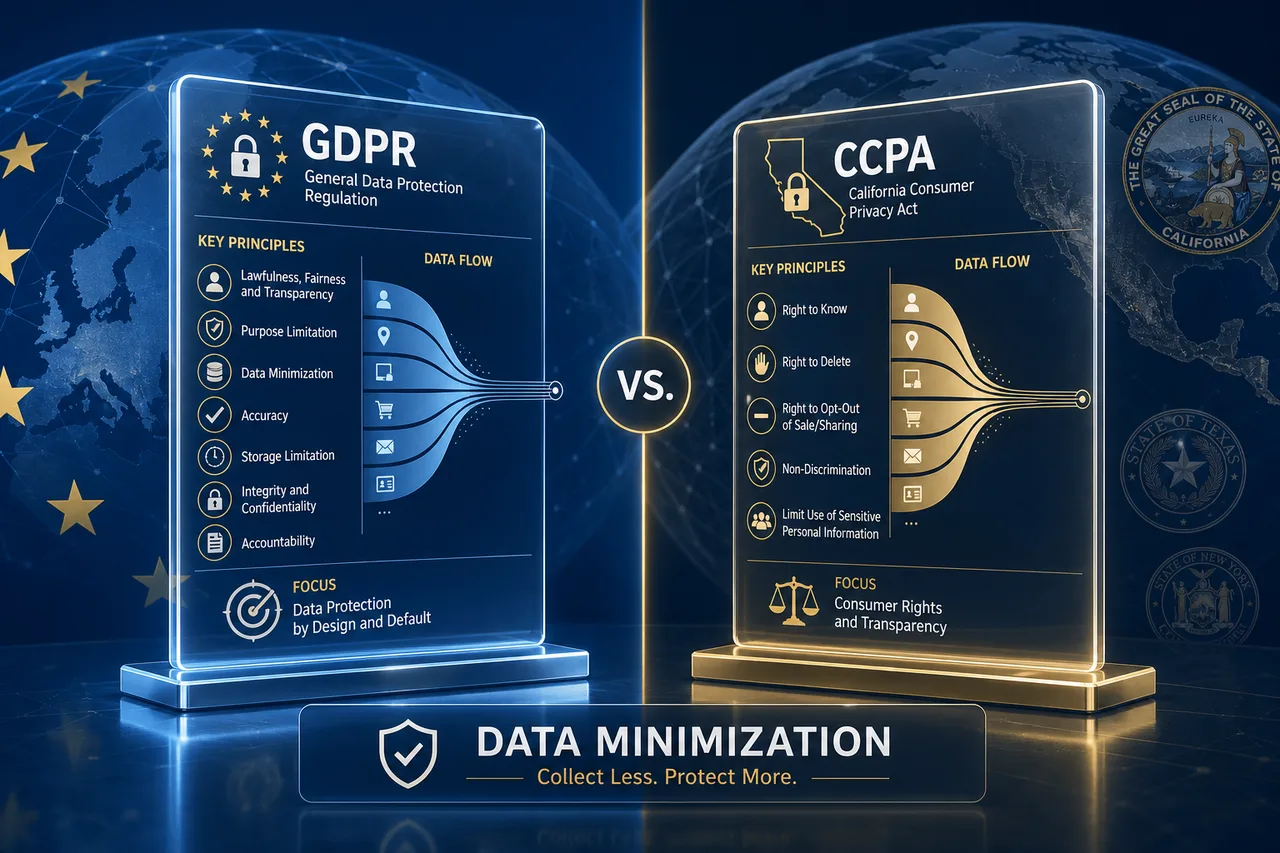
How Does Data Minimization Work in GDPR vs. CCPA
The GDPR and CCPA/CPRA both require data minimization but approach enforcement differently.
| Dimension | GDPR (EU) | CPRA (California) |
|---|---|---|
| Legal basis | Article 5(1)(c), explicit principle | Civil Code 1798.100(a)(3) |
| Scope | Any org processing EU resident data | For-profit businesses meeting thresholds |
| Enforcement | Data protection authorities, fines up to 4% global turnover | California Privacy Protection Agency |
| Consent management | Required for non-legitimate-interest processing | Opt-out model with minimization overlay |
| Retention link | Tied to storage limitation principle | Tied to stated purpose at collection |
Under the GDPR, data minimization is a proactive obligation, organizations must justify every data field before collection begins. The CPRA takes a slightly different approach, requiring that data collected be "reasonably necessary and proportionate" to the disclosed purpose [3]. Both frameworks demand that purpose be defined before data is collected, not rationalized after the fact.
Which Countries Require Data Minimization
Over 160 countries have enacted data protection laws that incorporate data minimization principles as of 2026 [1]. The principle appears across every major regional framework:
- European Union, GDPR, Article 5(1)(c)
- United States, HIPAA (healthcare), CPRA (California), and a growing list of state-level laws [3][5]
- Canada, PIPEDA, Principle 4 (Limiting Collection) [8]
- Switzerland, Federal Act on Data Protection [8]
- Asia-Pacific, APEC Privacy Framework and CBPR system [4][8]
- OECD member states, Collection Limitation Principle in OECD Privacy Guidelines [8]
The convergence is not accidental. As cross-border data flows have grown, regulators have found data minimization to be the most transferable principle because it does not require harmonization of enforcement mechanisms, only agreement on the underlying norm.
What Are Examples of Data Minimization in Practice
Data minimization in practice means redesigning data collection forms, APIs, and systems to capture only what is demonstrably needed.
Concrete examples:
- An e-commerce checkout form that asks for a delivery address but does not require a phone number unless the courier explicitly needs it for delivery confirmation.
- A SaaS onboarding flow that collects an email address for account creation but does not request date of birth unless age verification is legally required.
- A mobile app that requests location access only while the app is in use, rather than continuous background tracking.
- A healthcare provider that shares only the specific diagnosis codes relevant to a billing claim, not the full patient record, in line with HIPAA's minimum necessary standard [5].
- A GraphQL Web API configured with a "Janus"-style policy layer that filters response fields to exclude personal data not required by the requesting service [7].
In machine learning contexts, a 2024 study introduced an optimization framework specifically designed to enforce data minimization during model training, recognizing that AI systems often ingest far more personal data than model performance requires [6].
How Do I Implement Data Minimization in My Company
Implementing data minimization requires a structured, repeatable process rather than a one-time audit. The following steps apply to organizations of any size:
- Conduct a data inventory. Map every data field collected across all touchpoints, web forms, mobile apps, CRM systems, analytics tools, and third-party integrations.
- Define purpose for each field. For every field, document the specific business or legal purpose it serves. If no clear purpose exists, flag it for removal.
- Apply the necessity test. Ask: could the same outcome be achieved with less data or anonymized data? If yes, reduce the collection.
- Update privacy notices. Ensure that what you collect matches what your privacy policy states you collect.
- Configure consent mechanisms. Use a consent management platform like Biscotti CMP to enforce purpose-based data collection at the point of user interaction, ensuring that only consented and necessary data flows into downstream systems.
- Establish a review cadence. Data minimization is not a one-time exercise. Schedule quarterly or annual reviews to remove obsolete fields as business purposes evolve.
- Train relevant staff. Developers, marketers, and product managers all make data collection decisions. Training ensures minimization is applied at the design stage, not retrofitted later.
Data Minimization vs. Data Retention: What Is the Difference
Data minimization governs what data you collect; data retention governs how long you keep it. They are complementary but address different stages of the data lifecycle.
- Data minimization applies at the point of collection: do not gather data you do not need.
- Data retention applies after collection: do not keep data longer than necessary for the stated purpose.
Both principles appear together in the GDPR, minimization under Article 5(1)(c) and storage limitation under Article 5(1)(e). A common mistake is treating retention policies as a substitute for minimization: deleting data after two years does not justify collecting unnecessary data in the first place.
What Happens If You Do Not Follow Data Minimization Rules
Non-compliance with data minimization obligations carries legal, financial, and reputational consequences. Under the GDPR, violations of core data processing principles, including minimization, can attract fines of up to 4% of global annual turnover or 20 million euros, whichever is higher [2]. The CPRA empowers the California Privacy Protection Agency to issue civil penalties for violations [3].
Beyond fines, excessive data collection directly increases breach exposure. Every unnecessary data field is a liability in the event of a cyberattack. Regulators have also begun treating over-collection as evidence of poor data governance, which can compound enforcement outcomes.
Common mistake: Many organizations assume that obtaining user consent covers any data collection. Consent is a legal basis for processing, but it does not override the minimization principle. Collecting unnecessary data with consent is still a violation under GDPR.
Common Mistakes Companies Make With Data Minimization
Several patterns of non-compliance recur across organizations of all sizes:
- Collecting data "just in case." Building data collection around hypothetical future uses rather than defined current purposes is the most frequent violation.
- Ignoring legacy systems. Data minimization audits often focus on new products while legacy databases continue accumulating unnecessary fields.
- Conflating marketing analytics with necessity. Behavioral tracking for advertising optimization rarely meets the necessity threshold under GDPR without explicit consent.
- Failing to review third-party integrations. Analytics tools, CRM plugins, and ad pixels often collect data independently of the primary application. Each integration requires its own minimization assessment.
- No documentation. Even when minimization is practiced, the absence of documented purpose-limitation decisions creates compliance gaps during regulatory reviews.
Data Minimization for Small Businesses vs. Enterprises
The legal obligation is the same regardless of company size, but implementation complexity differs significantly.
Small businesses typically have fewer data touchpoints and can achieve compliance through a focused audit of their website forms, email marketing lists, and any third-party tools. The primary risk for small businesses is unconscious over-collection through default settings in analytics or CRM platforms.
Enterprises face more complex challenges: multiple business units, cross-border data flows, legacy systems with poorly documented data fields, and a larger surface area for third-party integrations. Enterprise data minimization programs typically require a formal data governance structure, a dedicated data protection officer (where required by law), and automated tools to enforce minimization at the API and database layer.
For both segments, deploying a consent management platform such as Biscotti CMP provides a practical starting point by ensuring that user-facing data collection is gated by purpose-specific consent, which directly supports minimization compliance.
How Does Data Minimization Affect Customer Experience
Counterintuitively, data minimization often improves customer experience rather than degrading it. Shorter forms reduce friction and increase conversion rates. Users who are asked only for information that is clearly relevant to the service they are receiving report higher trust levels. Transparency about what data is collected and why is consistently associated with stronger brand perception.
The practical implication: data minimization is not a constraint on product design; it is a design discipline that forces clarity about what data actually drives value. Organizations that have completed thorough minimization exercises frequently discover that a significant portion of the data they collected was never analyzed or acted upon.
Interactive Data Minimization Compliance Checker
FAQ
What is the simplest definition of data minimization? Collect only the personal data you genuinely need for a specific, stated purpose, nothing more, nothing less.
Does data minimization apply to B2B data? Yes. Most privacy frameworks, including the GDPR, apply to any personal data, including contact information for business professionals. B2B organizations are not exempt.
Can anonymized data be collected freely under data minimization rules? Truly anonymized data, where re-identification is not reasonably possible, falls outside most privacy frameworks. However, pseudonymized data (where re-identification is possible with additional information) remains subject to data minimization requirements.
Does data minimization conflict with big data analytics? It creates tension but not an absolute conflict. Organizations can pursue analytics goals using aggregated, anonymized, or synthetic data. The 2024 optimization framework for data minimization in machine learning demonstrates that model performance and minimization can be balanced [6].
What is the difference between data minimization and privacy by design? Privacy by design is the broader principle of embedding privacy protections into system architecture from the start. Data minimization is one specific requirement within that framework, it addresses the volume and scope of data collected.
How does a consent management platform support data minimization? A consent management platform like Biscotti CMP enforces purpose-specific consent at the point of data collection, ensuring that users only consent to data uses that have been disclosed and that downstream systems receive only the data associated with granted purposes.
Is data minimization the same across all GDPR member states? The principle is uniform across the EU under the GDPR, but national data protection authorities may interpret and enforce it with varying degrees of strictness. Germany and France, for example, have historically applied rigorous interpretations.
What data is always safe to collect under data minimization? No category of data is automatically "safe" to collect in unlimited quantities. Safety depends entirely on whether collection is necessary for a defined purpose. Even a name and email address can be an over-collection if the service does not require identification.
How long does a data minimization audit take? For a small business with limited data touchpoints, a thorough audit can be completed in one to two weeks. For an enterprise with multiple systems and cross-border flows, a formal audit typically takes two to four months.
Conclusion
Data minimization is not a compliance checkbox, it is an architectural discipline that shapes how organizations design products, configure systems, and build customer relationships. As the principle has now been codified across over 160 national frameworks [1], from the GDPR and CPRA to PIPEDA, APEC CBPR, and HIPAA, the question is no longer whether to implement it but how effectively.
Actionable next steps for 2026:
- Run a full data inventory and document the purpose for every field currently collected.
- Apply the necessity test: remove or anonymize any field that fails it.
- Review all third-party integrations, analytics, advertising, and CRM tools, against your minimization policy.
- Configure your consent management setup through a purpose-specific platform such as Biscotti CMP to enforce minimization at the point of collection.
- Schedule recurring audits so that minimization remains current as products and business purposes evolve.
Organizations that treat data minimization as a design principle, rather than a legal burden, consistently find that it reduces breach risk, simplifies compliance, and builds the kind of user trust that translates into long-term business value.
References
[1] Global Data Privacy Laws Frameworks Rights And Compliance - https://legalclarity.org/global-data-privacy-laws-frameworks-rights-and-compliance/?utm_source=openai
[2] Data Minimization - https://www.onetrust.com/glossary/data-minimization/?utm_source=openai
[3] Data Minimization An Increasingly Global Concept - https://connectontech.bakermckenzie.com/data-minimization-an-increasingly-global-concept/?utm_source=openai
[4] Global Privacy Frameworks Apec Cbpr - https://www.concord.tech/docs/global-privacy-frameworks-apec-cbpr?utm_source=openai
[5] Data Minimization Practices - https://nationalprivacyauthority.com/data-minimization-practices?utm_source=openai
[6] arxiv (2024) - https://arxiv.org/abs/2405.19471?utm_source=openai
[7] arxiv (2022) - https://arxiv.org/abs/2203.09903?utm_source=openai
[8] Data Minimization - https://en.wikipedia.org/wiki/Data_minimization?utm_source=openai