
Quick Answer
Google Consent Mode v2 is a mandatory update to Google's consent framework that introduced two new parameters, ad_user_data and ad_personalization, required for compliance with the EU's Digital Markets Act. Any website using Google Ads or Google Analytics 4 to reach users in the EEA or UK must implement it or face the loss of conversion tracking, remarketing, and personalized advertising capabilities. As of July 21, 2025, Google began active enforcement, making delayed implementation a direct threat to ad performance and measurement accuracy.
Key Takeaways
- Google Consent Mode v2 has been mandatory for EEA and UK-targeting websites since March 6, 2024, with active enforcement beginning July 21, 2025 [1]
- Two new consent parameters,
ad_user_dataandad_personalization, were added alongside the existinganalytics_storageandad_storage[1] - Non-compliant accounts have reported up to 90% loss in conversion data [1]
- Advanced mode implementation using cookieless pings can recover over 70% of lost conversions through statistical modeling [2]
- Approximately 67% of existing Consent Mode v2 implementations contain configuration errors that cause silent data loss [1]
- A Google-certified Consent Management Platform (CMP) is required for proper implementation [3]
- As of June 15, 2026, Google retired Google Signals, making
ad_storagethe sole governing parameter for advertising data in linked GA4 accounts [1] - Implementation requires a strict two-phase code pattern that must execute in the correct sequence [2]
- Websites outside the EEA and UK are not currently required to implement Consent Mode v2, but doing so is considered best practice for global data governance
- Small advertisers face additional challenges because they may not meet the modeling thresholds needed for effective conversion recovery [2]
What Is Google Consent Mode v2 and Why Does It Matter
Google Consent Mode v2 is an updated version of Google's consent signaling framework that tells Google's tags how to behave based on a user's consent choices. It matters because it directly governs whether Google Ads and GA4 can collect, process, and model user data, and non-compliance now has measurable financial consequences.
The framework bridges the gap between user privacy preferences and advertiser measurement needs. When a user declines cookies, Consent Mode v2 doesn't simply block all data collection. Instead, in Advanced mode, it sends cookieless pings that allow Google to model conversions statistically, preserving a meaningful portion of campaign intelligence without violating user consent.
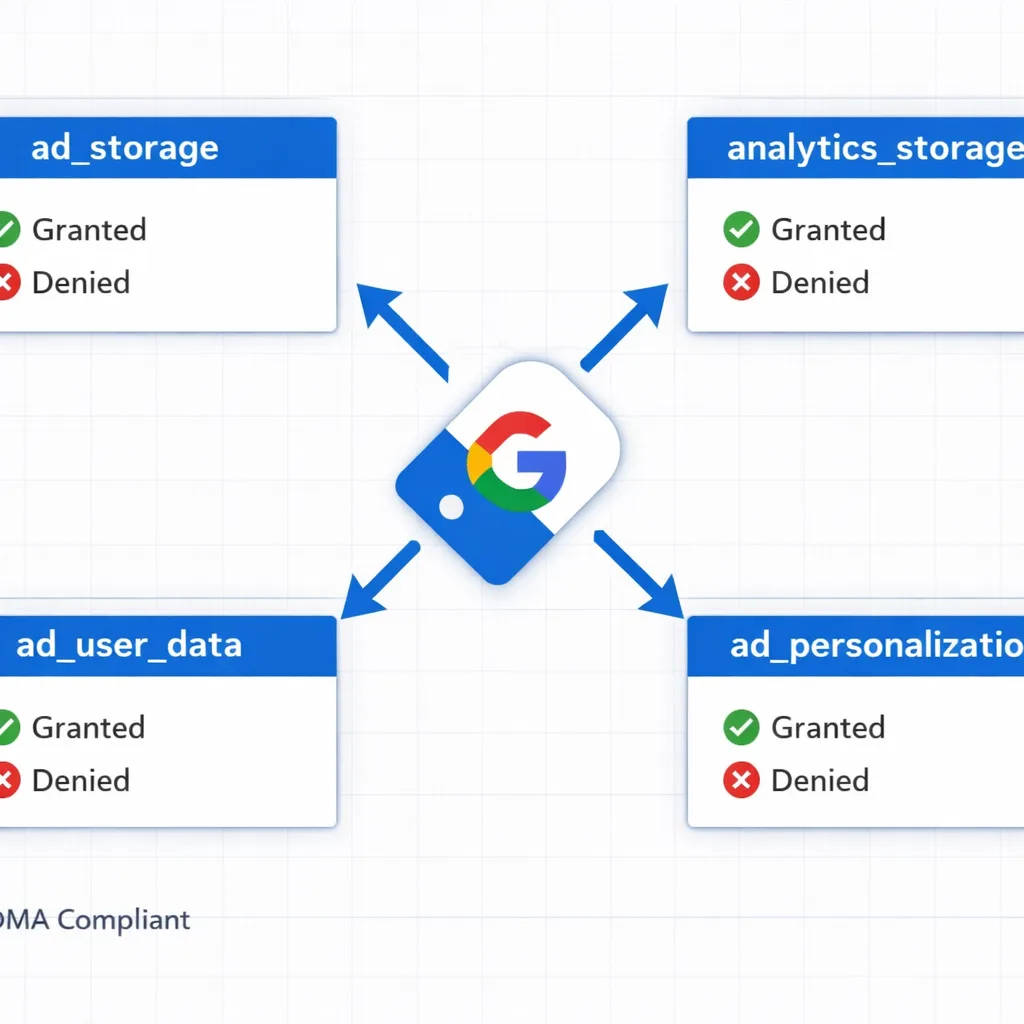
The two new parameters introduced in v2, ad_user_data and ad_personalization, were specifically added to satisfy the EU's Digital Markets Act requirements. These parameters give users granular control over whether their data is used to build advertising profiles and whether personalized ads can be served to them [1].
When Do You Have to Implement Google Consent Mode v2
The mandatory deadline for EEA and UK-targeting websites was March 6, 2024. Google began enforcing compliance on July 21, 2025, at which point non-compliant accounts lost access to personalized ads, remarketing audiences, and conversion tracking for traffic from those regions [1].
If your website was not compliant before July 2025, the enforcement has already affected your campaigns. Implementing Google Consent Mode v2 today remains critical because the enforcement is ongoing, not a one-time penalty. Every day without proper implementation is a day of degraded measurement and restricted ad targeting.
A critical update as of June 15, 2026: Google retired Google Signals, which previously contributed cross-device data to GA4. With Signals gone, ad_storage is now the sole parameter governing advertising data in GA4-linked accounts, making accurate consent parameter configuration even more consequential [1].
How Is Consent Mode v2 Different from v1
Consent Mode v1 used two parameters: analytics_storage and ad_storage. Version 2 adds ad_user_data and ad_personalization, which are specifically required by the Digital Markets Act.
| Parameter | Version | Controls |
|---|---|---|
analytics_storage |
v1 + v2 | Analytics cookies and measurement |
ad_storage |
v1 + v2 | Advertising cookies and ad click data |
ad_user_data |
v2 only | Sending user data to Google for ad purposes |
ad_personalization |
v2 only | Personalized advertising and remarketing |
The practical difference: in v1, an advertiser could technically satisfy basic cookie consent while still sending user data to Google for ad personalization. The v2 parameters close that gap, requiring explicit consent for each distinct data use case. Websites still running only v1 parameters are non-compliant and will have lost access to personalized advertising features for EEA and UK users [1] [4].
Do You Need Consent Mode v2 If You're Not in Europe
Consent Mode v2 is currently mandatory only for websites targeting users in the European Economic Area (EEA) and the United Kingdom. If your website operates exclusively in other regions, Google has not imposed a compliance requirement.
That said, implementing it globally is increasingly considered standard practice. Privacy regulations modeled on GDPR are expanding in scope across North America, Asia-Pacific, and Latin America. Configuring Consent Mode v2 site-wide now avoids the need for region-specific conditional logic and reduces the risk of inadvertent non-compliance as regulations evolve.
Choose global implementation if: your website serves any EEA or UK traffic, you plan to expand internationally, or your organization follows a unified data governance policy.
What Happens If You Don't Implement Google Consent Mode v2
Non-compliance with Google Consent Mode v2 results in direct, quantifiable losses to advertising and analytics capabilities. The consequences are not theoretical, they are already being applied.
Documented consequences include:
- Loss of conversion tracking for EEA and UK users
- Inability to serve personalized ads or build remarketing audiences in those regions
- Degraded Smart Bidding performance due to incomplete conversion signals
- One misconfigured account reported a 90% loss in conversion data [1]
Beyond immediate data loss, there is a compounding effect: Smart Bidding algorithms rely on conversion history to optimize bids. Weeks of degraded data can destabilize campaign performance well beyond the initial compliance gap.
How to Set Up Google Consent Mode v2 on Your Website
Proper implementation of Google Consent Mode v2 follows a two-phase pattern that must execute in a specific order [2].
Phase 1, Default state (fires before any Google tags load):