
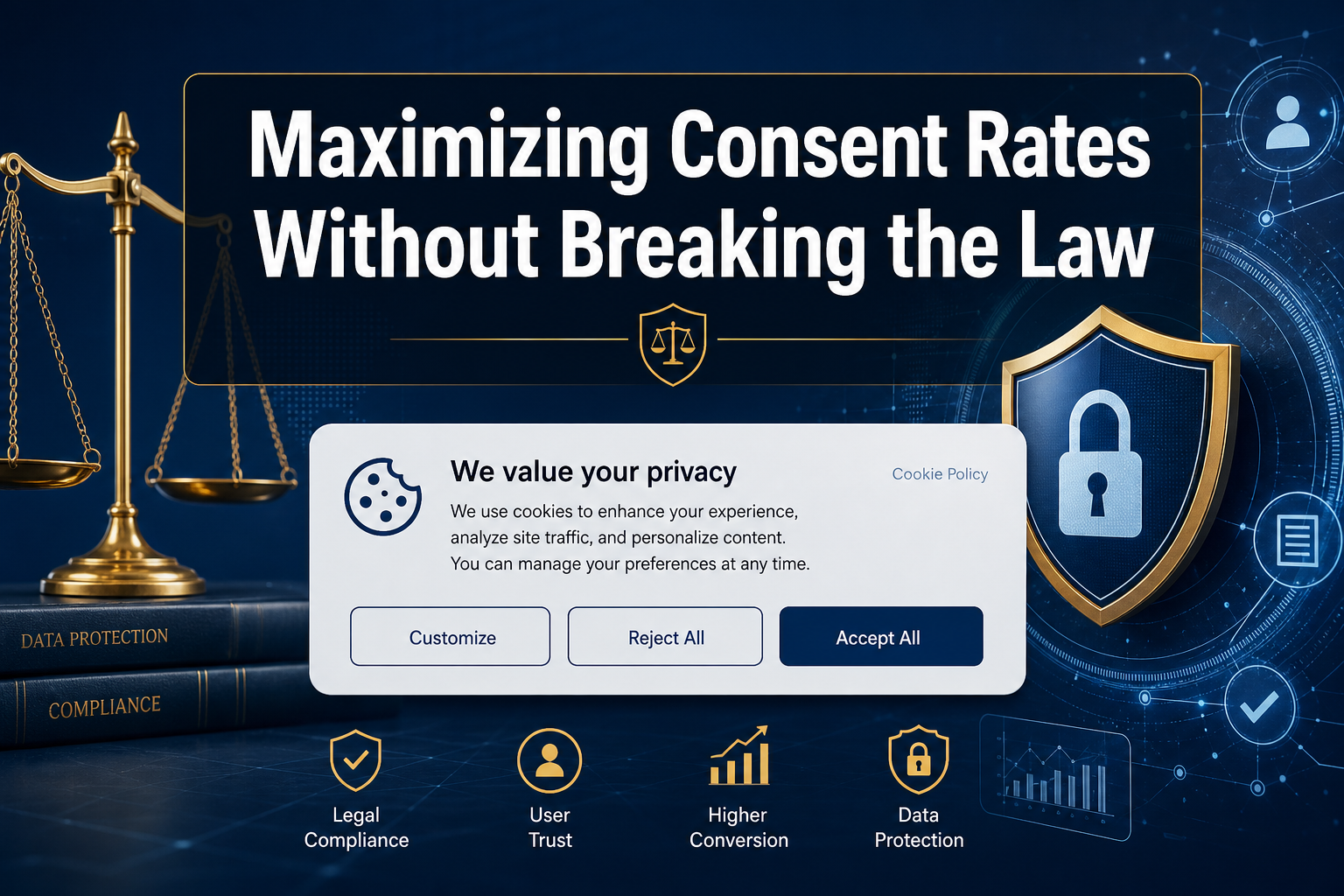
Quick Answer: Maximizing consent rates without breaking the law means designing transparent, user-friendly consent banners that present genuine choices, avoid manipulative design patterns, and fully comply with GDPR, CCPA, and similar regulations. The highest-performing compliant banners balance clear value communication with legal honesty, and they rely on a properly configured Consent Management Platform to enforce user choices across all tracking scripts.
Key Takeaways
- Consent rates vary significantly by industry: e-commerce sites average 45-55%, news sites 35-45%, and B2B SaaS platforms 60-70% [1]
- Banners with equally prominent Accept and Reject buttons are more legally compliant but typically yield lower consent rates (35-45%) than manipulative designs [2]
- Dark patterns in consent banners are explicitly illegal under EU law; fines exceeding 475 million euros were issued in September 2025 alone [6]
- Pre-ticked consent boxes are illegal under GDPR and have been since the regulation took effect
- 94.1% of consent forms across nearly 6,000 studied sites showed compliance violations [3]
- 57.5% of websites do not delete cookies after a user revokes consent, constituting continued illegal data processing [8]
- Traffic source affects consent rates by more than 36 percentage points, meaning audience quality matters as much as banner design [5]
- A properly implemented Consent Management Platform (CMP) is the foundational requirement for lawful consent collection and enforcement [7]
- Cookie walls are generally illegal under GDPR when access to content is conditioned solely on accepting tracking cookies
- Using consent rate as a KPI is valid, but only when measured alongside compliance metrics, not in isolation
What Is a Legal Consent Rate for Websites, and What Do GDPR Requirements Actually Demand
A "legal" consent rate is not a specific percentage mandated by law. GDPR does not require websites to achieve a minimum acceptance threshold. What the law requires is that any consent obtained is freely given, specific, informed, and unambiguous. The rate is a business metric; the quality and lawfulness of how that consent was obtained is the legal standard.
Under GDPR Article 7 and Recital 32, consent must be:
- Freely given: Users must have a genuine choice, with no penalty for refusing
- Specific: Consent for analytics cannot bundle consent for advertising
- Informed: Users must understand what they are agreeing to before clicking
- Unambiguous: A clear affirmative action is required, not silence or pre-selection
The UK ICO, France's CNIL, and Germany's DSK have each published enforcement guidance reinforcing that consent obtained through coercive or confusing designs does not meet these standards, regardless of the acceptance rate it produces.
Common mistake: Treating a high consent rate as proof of compliance. A 90% acceptance rate achieved through dark patterns is legally worthless and exposes operators to significant fines.
What Makes a Consent Banner Illegal, and What Are Dark Patterns to Avoid
A consent banner becomes illegal when its design manipulates users into accepting rather than presenting a genuine choice. The EU's enforcement record makes this concrete: dark patterns are not a gray area.
The most common illegal design patterns include:
- Asymmetric button prominence: Making "Accept All" a large, colorful button while "Reject" is a small gray link or buried in settings
- Pre-ticked boxes: Any checkbox that defaults to "on" for non-essential cookies is illegal under GDPR without exception
- Consent walls: Blocking all site content unless users accept tracking (addressed separately below)
- Misleading language: Using phrases like "I agree to a better experience" that obscure what users are actually consenting to
- Forced scrolling or clicking: Requiring users to scroll through lengthy text before a Reject option appears
- Repeated nudging: Re-presenting the banner immediately after a user declines, or on every page visit
In September 2025, companies including Google and SHEIN faced combined fines exceeding 475 million euros for deploying these tactics [6]. The French data protection authority CNIL has been particularly active in this enforcement area.
"The design of a consent interface is itself a legal document. If the interface steers users toward a particular outcome, the resulting consent is not valid."
Is Pre-Ticked Consent Legal, and What Is the Difference Between Implied and Explicit Consent
Pre-ticked consent boxes are unambiguously illegal under GDPR. The Court of Justice of the European Union confirmed this in the Planet49 ruling: a pre-checked checkbox does not constitute valid consent because it requires no affirmative action from the user.
Explicit consent requires a user to take a deliberate, positive action, such as clicking an unchecked box or pressing an "Accept" button, with full knowledge of what they are agreeing to. This is the standard required for non-essential cookies and most forms of behavioral tracking under GDPR.
Implied consent (sometimes called "soft opt-in") is a lower standard that applies in narrower contexts. Under the UK's PECR, for example, implied consent may be acceptable for certain direct marketing to existing customers, but it does not satisfy GDPR's requirements for cookie consent or data processing based on consent as a lawful basis.
Choose explicit consent if: your site operates in the EU/EEA, processes sensitive data, or relies on consent as the lawful basis for any tracking activity. Implied consent is not a compliant substitute in these contexts.
Are Cookie Walls Legal Under GDPR
Cookie walls, which deny users access to website content unless they accept all tracking cookies, are generally considered non-compliant with GDPR's requirement that consent be freely given. The Dutch DPA and France's CNIL have both issued decisions against cookie walls on the grounds that users have no genuine alternative.
However, a nuanced exception exists: the "pay or consent" model, where users can either accept tracking or pay a subscription fee for a tracker-free experience, has received conditional acceptance from some EU data protection authorities, including the EDPB's 2024 opinion on large online platforms. This model remains legally contested and should only be implemented with qualified legal advice.
Practical rule: If your site's only options are "accept all cookies" or "leave the site," that is a cookie wall and is non-compliant under GDPR.
How to Increase Cookie Consent Acceptance Rates Without Legal Risk
Maximizing consent rates without breaking the law is achievable through ethical design and genuine transparency. The goal is to give users a reason to consent, not to confuse them into it.
Proven compliant strategies include:
- Explain the value exchange clearly. Tell users specifically what enabling analytics or personalization does for their experience. Vague language reduces trust and acceptance.
- Use plain language. Legal jargon in consent banners reduces comprehension and acceptance. Short, direct sentences perform better.
- Optimize banner timing and placement. A banner that appears after a user has engaged with content (rather than immediately on landing) may achieve higher acceptance because the user has already derived value from the site.
- Offer granular consent options. Some users will accept analytics but not advertising. Granular controls can increase partial consent rates while respecting user preferences.
- Build trust signals into the banner. Displaying a privacy certification badge, a clear privacy policy link, or a brief statement about data handling can meaningfully improve acceptance.
- Test banner copy, not just design. A/B testing the explanatory text in a banner is a compliant optimization lever that is frequently underused.
Banners with equally prominent Accept and Reject buttons typically achieve 35-45% consent rates, while those that emphasize the Accept option can reach 60-75%, but the latter carry significant compliance risk [2]. The compliant path is to close that gap through transparency, not manipulation.
Consent Rate Benchmarks by Industry
Consent rates are not uniform across site types. Understanding where your site sits relative to industry norms helps set realistic KPIs and identify genuine optimization opportunities.
| Industry | Typical Consent Rate | Key Driver |
|---|---|---|
| B2B SaaS | 60-70% | High-intent, informed audience |
| E-commerce | 45-55% | Personalization value proposition |
| News / Media | 35-45% | High volume, low engagement sessions |
| Healthcare / Finance | 40-55% | Trust-sensitive; clear value needed |
Source: [1]
Traffic source also plays a significant role. Visitors arriving from privacy-focused browsers or search engines may consent at rates more than 36 percentage points lower than visitors from standard channels [5]. This means that aggregate consent rate figures can be misleading without segmentation by traffic source.
Can consent rate be used as a KPI? Yes, but only alongside compliance metrics. Tracking acceptance rate, granular consent distribution (what categories users accept), revocation rate, and technical enforcement accuracy together provides a meaningful picture. A high acceptance rate with poor revocation enforcement is a compliance liability, not a success metric.
How Long Should Consent Banners Stay Visible, and How Do I Know My Process Complies
Consent banners should remain visible until the user makes an active choice. Banners that auto-dismiss after a timer, or that disappear when a user scrolls, do not capture valid consent under GDPR because no affirmative action has occurred.
For consent duration, GDPR does not specify a maximum validity period, but the CNIL recommends a maximum of 13 months before re-requesting consent. Most CMPs default to 12 months.
Compliance checklist for consent processes:
- No cookies fire before a user makes a choice (requires proper CMP technical implementation)
- Reject/decline option is as easy to access as Accept
- Consent records are stored with timestamp, version of the banner shown, and user choice
- Consent can be revoked as easily as it was given
- Revocation triggers actual deletion or blocking of cookies, not just a preference update [8]
- Third-party scripts are blocked until consent is granted for their category
A study found that 57.5% of websites do not delete cookies after consent revocation [8], and only 3.82% of popular sites correctly enforce consent choices technically [3]. These figures underscore that legal consent is as much a technical problem as a design problem.
What Happens If Consent Rates Are Too Low, and What Role Does a CMP Play
Low consent rates are not a legal problem in themselves. They become a business problem when they reduce the data available for analytics or advertising. The appropriate response is ethical optimization, not design manipulation.
A Consent Management Platform (CMP) is the technical backbone of any compliant consent process. A CMP handles consent collection, stores records of user choices, communicates those choices to all downstream tracking scripts and third-party vendors, and provides the audit trail needed to demonstrate compliance to regulators [7].
Without a properly configured CMP, even a well-designed banner fails at the enforcement layer. The consent signal must propagate to every tag, pixel, and third-party integration on the site. Manual implementations frequently fail this requirement.
Biscotti CMP (www.biscotti-cmp.com) is designed specifically to address both the legal enforcement and consent rate optimization challenges described in this guide. It provides granular consent controls, automatic script blocking, consent record storage, and banner customization tools that support compliant A/B testing without enabling dark patterns.
Best Practices for Consent Banner Design in 2026
The following practices represent the current standard for compliant, high-performing consent banners, drawing on regulatory guidance and published research.
Design principles:
- Equal visual weight for Accept and Reject options at the primary banner level
- Layered information: A short, clear primary banner with a "More options" link for granular controls, rather than overwhelming users with detail upfront
- Mobile-first layout: Banners that obscure most of the screen on mobile without a clear dismiss option create friction and legal risk
- Consistent branding: Banners that match site design are perceived as more trustworthy than generic pop-ups
Technical requirements:
- Implement a CMP that integrates with your tag management system
- Ensure consent signals propagate to all third-party vendors before any data collection begins
- Log consent with version control so that if your banner changes, you can identify which version a user consented to
- Test revocation flows as rigorously as acceptance flows
Legal review cadence: Revisit consent banner copy and design whenever you add new data processing activities, change vendors, or when relevant regulatory guidance is updated.
Conclusion
Maximizing consent rates without breaking the law requires accepting a fundamental constraint: the design tactics most likely to inflate acceptance rates are the same ones regulators are actively fining. The sustainable path is to earn consent through transparency, clear value communication, and technically sound enforcement.
Actionable next steps for website operators:
- Audit your current consent banner against the dark patterns list above and remove any asymmetric design elements
- Verify technically that no cookies fire before a user makes an active choice
- Test your revocation flow to confirm cookies are actually deleted, not just flagged
- Segment your consent rate data by traffic source and device type to identify genuine optimization opportunities
- Implement or upgrade to a CMP such as Biscotti CMP that provides both compliant enforcement and banner performance analytics
- Set a calendar reminder to re-request consent from existing users within 12-13 months of their last choice
The compliance landscape in 2026 is not forgiving of technical shortcuts or manipulative design. But operators who invest in genuine transparency consistently find that user trust, once earned, produces more durable consent rates than any dark pattern ever could.
FAQ
What is a good consent rate for a website? A good consent rate depends on your industry. B2B SaaS sites typically achieve 60-70%, e-commerce 45-55%, and news sites 35-45%. These benchmarks assume compliant banner designs with equal Accept/Reject prominence [1].
Is a 100% consent rate a red flag? Yes. A consent rate approaching 100% almost always indicates a non-compliant design, such as a cookie wall, a missing Reject option, or pre-ticked boxes. Regulators treat suspiciously high rates as evidence of coercion.
How often should I re-request consent from users? The CNIL recommends re-requesting consent after a maximum of 13 months. Most CMPs default to 12 months. You must also re-request consent if you materially change your data processing activities.
Can I A/B test my consent banner? Yes, A/B testing banner copy, layout, and explanatory text is a compliant optimization strategy. Testing that involves removing or hiding the Reject option is not compliant.
What is the difference between GDPR and CCPA consent requirements? GDPR requires opt-in consent before non-essential data processing begins. CCPA/CPRA operates on an opt-out model, where data processing can begin but users must be given a clear mechanism to opt out of the sale or sharing of their personal information.
Do I need a CMP if my site only uses Google Analytics? Yes, if your site operates in the EU/EEA. Google Analytics 4 uses cookies and processes personal data, which requires valid consent under GDPR before the tracking fires.
What records do I need to keep for consent compliance? You must store: the timestamp of consent, the version of the banner shown, the user's specific choices (by category), and evidence that those choices were technically enforced. A properly configured CMP handles this automatically [7].
Are implied consent or "continued browsing" clauses valid under GDPR? No. GDPR requires an unambiguous affirmative action. A statement like "by continuing to browse you accept cookies" does not constitute valid consent.
What happens if a user revokes consent? You must stop processing data under that consent basis immediately and delete or block any cookies or data collected under the revoked consent. 57.5% of websites currently fail to do this correctly [8].
Can traffic source explain low consent rates? Yes. Visitors from privacy-focused browsers or search tools may consent at rates more than 36 percentage points lower than other visitors [5]. Segmenting consent data by traffic source is essential for accurate benchmarking.
References
[1] What Is A Good Consent Rate - https://fitconsent.com/en/compliance/what-is-a-good-consent-rate?utm_source=openai
[2] Improve Cookie Consent Rates - https://kukie.io/blog/improve-cookie-consent-rates?utm_source=openai
[3] Gdpr Cookie Consent Works - https://www.securityscientist.net/blog/gdpr-cookie-consent-works/?utm_source=openai
[4] 75% of Most Visited Websites in U.S. and Europe Are Not Compliant - https://focusonbusiness.eu/en/news/75-of-most-visited-websites-in-u-s-and-europe-are-not-compliant-with-privacy-regulations/6475?utm_source=openai
[5] Traffic Source Consent Rates - https://kukie.io/blog/traffic-source-consent-rates?utm_source=openai
[6] Cookie Consent Rates Optimization - https://www.cookient.app/blog/cookie-consent-rates-optimization?utm_source=openai
[7] Consent Management Platform CMP Setup And Compliance - https://legalclarity.org/consent-management-platform-cmp-setup-and-compliance/?utm_source=openai
[8] arxiv - https://arxiv.org/abs/2411.15414?utm_source=openai
[9] arxiv - https://arxiv.org/abs/2309.00776?utm_source=openai
[10] How To Improve Consent Rate While Avoiding Dark Patterns - https://www.iubenda.com/en/blog/how-to-improve-consent-rate-while-avoiding-dark-patterns/?utm_source=openai