
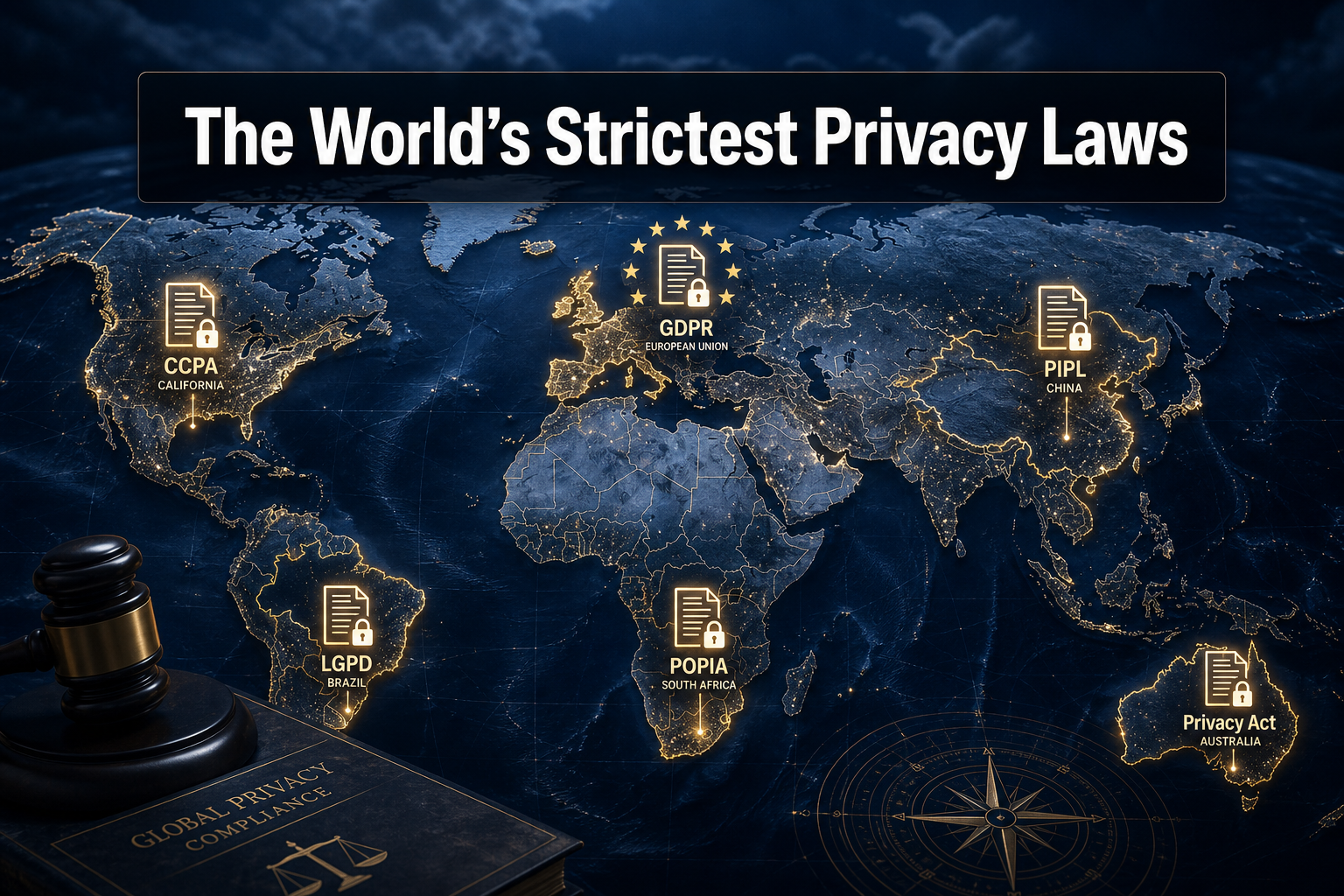
Quick Answer: The world's strictest privacy laws, led by the EU's GDPR, China's PIPL, and California's CCPA, impose significant financial penalties and extend their reach far beyond their home borders. Any organization that collects or processes personal data from residents in these jurisdictions must comply, regardless of where that organization is physically located. Understanding territorial scope and sanction structures is the first step toward building a defensible compliance posture.
Key Takeaways
- Over 160 countries have enacted comprehensive data privacy legislation, making global compliance a baseline expectation, not an exception [1].
- The GDPR carries the highest financial penalties of any privacy law: up to €20 million or 4% of global annual revenue, whichever is greater [1].
- GDPR enforcement fines have exceeded €7 billion since enforcement began, with major penalties against Meta, Amazon, and TikTok [7].
- China's PIPL and the EU's GDPR both apply extraterritorially, foreign companies serving residents in those jurisdictions must comply [1].
- The U.S. lacks a unified federal privacy law; compliance depends on sector and state, with California's CCPA being the most influential state-level framework [2].
- Territorial scope determines which law applies to your business; multiple laws can apply simultaneously to a single organization.
- Small businesses are not automatically exempt, CCPA thresholds and GDPR's "establishment" test can capture companies of many sizes.
- Common compliance failures include inadequate consent mechanisms, poor data mapping, and ignoring cross-border transfer rules.
- A Consent Management Platform (CMP) such as Biscotti CMP can help organizations operationalize consent requirements under multiple frameworks.
What Are the World's Strictest Privacy Laws by Country
The strictest privacy laws globally are the EU's General Data Protection Regulation (GDPR), China's Personal Information Protection Law (PIPL), Brazil's Lei Geral de Proteção de Dados (LGPD), and California's CCPA/CPRA. Each combines broad territorial reach with meaningful enforcement teeth.
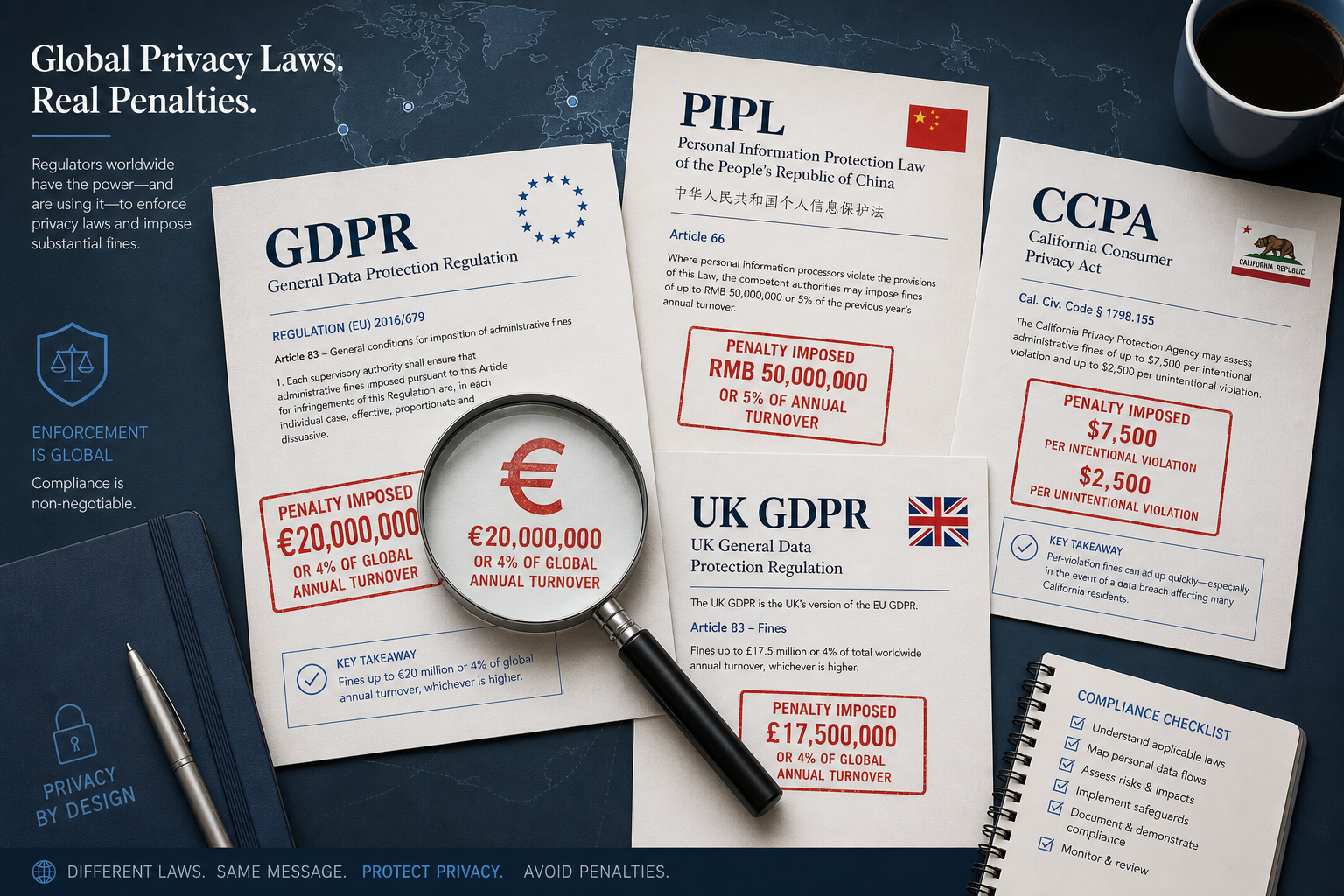
Here is a concise comparison of the major frameworks:
| Law | Jurisdiction | Max Penalty | Extraterritorial? | Effective Since |
|---|---|---|---|---|
| GDPR | European Union | €20M or 4% global revenue | Yes | May 2018 |
| UK GDPR | United Kingdom | £17.5M or 4% global revenue | Yes | Jan 2021 |
| PIPL | China | Up to ¥50M or 5% annual revenue | Yes | Nov 2021 |
| CCPA/CPRA | California, USA | Up to $7,988 per intentional violation | Limited | Jan 2020 |
| LGPD | Brazil | Up to 2% of Brazil revenue, capped at R$50M | Yes | Sep 2020 |
The GDPR remains the global benchmark. Its combination of high penalties, broad scope, and active enforcement makes it the framework most organizations prioritize first when building international compliance programs [1].
How Do GDPR Sanctions Work and What Are the Penalties
GDPR sanctions operate on a two-tier penalty structure. Lower-tier violations, such as failing to maintain records of processing activities, can result in fines up to €10 million or 2% of global annual turnover. Upper-tier violations, including unlawful processing of personal data or ignoring data subject rights, carry penalties up to €20 million or 4% of global annual revenue, whichever is higher [1].
Beyond fines, supervisory authorities can issue temporary or permanent bans on data processing, which in practice can be more damaging to a business than the monetary penalty itself. Since enforcement began, cumulative GDPR fines have exceeded €7 billion, with landmark cases against Meta Ireland, Amazon Luxembourg, and TikTok [7].
Key factors regulators weigh when calculating fines:
- Nature, gravity, and duration of the violation
- Whether the violation was intentional or negligent
- Cooperation with the supervisory authority
- Prior infringement history
- Categories of personal data affected (health, financial, or biometric data attract heavier scrutiny)
Difference Between GDPR, CCPA, and Other Privacy Regulations
The GDPR and CCPA share the same goal, protecting personal data, but differ significantly in scope, rights granted, and enforcement mechanisms [2].
GDPR applies to any organization processing EU residents' data, regardless of company size. It requires a lawful basis for every processing activity, mandates data protection impact assessments for high-risk processing, and grants individuals rights including access, erasure, portability, and objection.
CCPA/CPRA applies only to for-profit businesses meeting at least one of these thresholds: annual gross revenue exceeding $25 million, buying or selling personal data of 100,000 or more California consumers annually, or deriving 50% or more of annual revenue from selling personal data [2]. It focuses more on transparency and opt-out rights than on requiring a lawful basis for processing.
PIPL (China) mirrors GDPR in structure but adds stricter data localization requirements and mandates government security assessments before transferring "important" data abroad [1].
The practical difference: GDPR is opt-in by default for most processing; CCPA is largely opt-out. PIPL blends both approaches while adding national security overlays that GDPR lacks.
What Is Territorial Scope in Privacy Law
Territorial scope defines the geographic boundaries within which a privacy law applies, and, critically, whether it reaches organizations operating outside those boundaries. Most modern privacy laws have adopted an extraterritorial model, meaning physical presence in a country is no longer required for compliance obligations to attach.
The GDPR's territorial scope is governed by Article 3, which applies the regulation to any organization established in the EU, and to organizations outside the EU that either offer goods or services to EU residents or monitor their behavior [1]. The UK GDPR follows an identical model [9].
China's PIPL applies to foreign entities that offer products or services to individuals in China, analyze or assess the behavior of individuals in China, or fall under circumstances defined in other applicable laws [1].
Navigating sanctions and territorial scopes: a look at the world's strictest privacy laws reveals a consistent pattern: the trend is toward maximum reach. Regulators want to prevent organizations from escaping obligations simply by incorporating offshore.
How Do Privacy Laws Apply to Companies Outside Their Country
Privacy laws apply to foreign companies through the concept of extraterritorial jurisdiction. A company headquartered in Singapore that runs a website targeting German consumers and collecting their email addresses is subject to GDPR, even without a single EU employee or office.
The triggers for extraterritorial application typically include:
- Actively marketing to residents of the jurisdiction (language, currency, local payment methods)
- Processing personal data of residents, even passively through analytics or cookies
- Monitoring behavior (behavioral advertising, tracking pixels)
- Operating a local establishment, even a small representative office
The U.S. DOJ's Data Security Program, effective April 8, 2025, adds another layer: it imposes export controls to prevent foreign adversaries from accessing sensitive U.S. personal data, prohibiting certain data transactions with designated "Countries of Concern" [5].
Common mistake: Assuming that because a company has no physical presence in a jurisdiction, it has no compliance obligations there. This is incorrect for GDPR, PIPL, UK GDPR, and LGPD.
Which Privacy Law Is Hardest to Comply With
The GDPR is widely considered the most demanding privacy law to comply with, for three reasons: the breadth of its requirements, the strictness of its consent standards, and the volume of enforcement actions taken by EU supervisory authorities.
GDPR compliance requires organizations to document every processing activity, appoint a Data Protection Officer in certain cases, conduct Data Protection Impact Assessments for high-risk processing, and implement "privacy by design and by default" across all systems. The consent standard under GDPR, freely given, specific, informed, and unambiguous, is considerably more demanding than the opt-out model under CCPA [2].
China's PIPL is a close second, particularly for multinational companies, because it combines GDPR-level consent requirements with data localization mandates and government security review processes for cross-border transfers [1][4].
Choose GDPR as your baseline compliance standard if your organization serves any EU or UK residents. Meeting GDPR requirements will satisfy most of the substantive demands of UK GDPR, and will position you well for LGPD and PIPL compliance with incremental adjustments.
What Happens If You Violate GDPR or CCPA Regulations
GDPR violations can result in fines up to €20 million or 4% of global annual revenue, enforcement orders, processing bans, and reputational damage from mandatory breach notifications [1]. Supervisory authorities across EU member states have demonstrated a clear willingness to impose significant fines on companies of all sizes.
CCPA violations are enforced by the California Privacy Protection Agency (CPPA). Civil penalties reach up to $2,663 per unintentional violation and $7,988 per intentional violation, adjusted annually for inflation [3]. Unlike GDPR, CCPA also provides a private right of action for data breaches, allowing consumers to sue directly.
Beyond financial penalties, the secondary consequences are often more damaging:
- Mandatory public disclosure of enforcement actions
- Loss of consumer trust and brand equity
- Operational disruption from processing bans
- Increased regulatory scrutiny across other jurisdictions
Do Privacy Laws Apply to Small Businesses or Just Large Companies
Privacy laws can apply to small businesses, though thresholds vary by framework. The GDPR has no revenue or size threshold, if a small business processes EU residents' personal data, it is subject to GDPR. The CCPA, by contrast, only applies to for-profit businesses meeting specific revenue or data volume thresholds, which means many small businesses fall outside its scope [2].
GDPR exemptions for small organizations are narrow: Businesses with fewer than 250 employees are partially exempt from maintaining detailed records of processing activities, but only if their processing is not likely to result in a risk to individuals' rights, is not occasional, or does not involve special categories of data.
Edge case: A sole-trader running a niche e-commerce store targeting EU customers and using behavioral advertising tools is almost certainly subject to GDPR, regardless of annual revenue.
Common Mistakes Companies Make with Privacy Law Compliance
The most frequent compliance failures are not technical, they are organizational. Companies routinely underestimate the scope of their data collection, fail to update privacy notices to reflect actual processing, and treat consent as a one-time checkbox rather than an ongoing relationship.
The top compliance mistakes, ranked by frequency:
- Inadequate consent mechanisms, Using pre-ticked boxes, bundled consent, or consent buried in terms of service.
- No lawful basis documented, Processing data without identifying and recording a valid legal basis under GDPR Article 6.
- Ignoring cross-border transfer rules, Transferring personal data to third countries without Standard Contractual Clauses or equivalent safeguards.
- Incomplete data mapping, Not knowing what personal data is collected, where it is stored, and who has access.
- Failing to honor data subject requests, Missing the 30-day response window for access, erasure, or portability requests.
- Outdated privacy notices, Publishing a notice that does not accurately describe current processing activities.
A properly configured CMP like Biscotti CMP addresses several of these failure points directly by managing consent collection, storage, and withdrawal across multiple regulatory frameworks.
How to Determine Which Privacy Laws Apply to Your Business
Determining applicable privacy laws requires answering four questions: Where is your organization established? Where are your users or customers located? What categories of personal data do you process? And do you meet any jurisdiction-specific thresholds?
A practical decision framework:
- If you have an establishment in the EU or UK, or you actively target EU/UK residents: GDPR and/or UK GDPR apply [1][9].
- If you offer goods or services to Chinese consumers or analyze their behavior: PIPL applies [1].
- If you are a for-profit company meeting California's revenue or data volume thresholds: CCPA/CPRA applies [2].
- If you operate in Brazil and process personal data of Brazilian residents: LGPD applies.
- If your business involves transferring sensitive U.S. personal data internationally: review the DOJ Data Security Program requirements [5].
Multiple laws can apply simultaneously. A U.S.-based SaaS company with EU customers, California employees, and a marketing database that includes Brazilian leads may need to comply with GDPR, CCPA, and LGPD concurrently.
Are There Privacy Laws That Don't Have Territorial Reach
Some privacy frameworks are intentionally limited in territorial scope. The DIFC Data Protection Law in Dubai, for example, applies to controllers and processors incorporated in the DIFC, or those processing data within the DIFC, but does not claim broad extraterritorial reach comparable to GDPR [8]. Similarly, many older or sector-specific U.S. federal laws (HIPAA for health data, FERPA for education records) apply based on the nature of the data and the type of entity, not on the location of data subjects.
However, the global trend is clearly toward broader territorial reach. Navigating sanctions and territorial scopes: a look at the world's strictest privacy laws shows that newer legislation, PIPL, LGPD, and the UK GDPR post-Brexit, all adopted extraterritorial models, signaling that limited-scope frameworks are becoming the exception rather than the rule.
How Do Sanctions Differ Between GDPR and Other Privacy Frameworks
GDPR sanctions are the most severe and most actively enforced of any global privacy framework, but the mechanisms differ meaningfully across regimes.
| Framework | Enforcement Body | Max Financial Penalty | Private Right of Action |
|---|---|---|---|
| GDPR | National supervisory authorities | €20M or 4% global revenue | Limited (varies by member state) |
| UK GDPR | ICO | £17.5M or 4% global revenue | Limited |
| PIPL | CAC / sector regulators | ¥50M or 5% annual revenue | Yes (for individuals) |
| CCPA/CPRA | CPPA | $7,988 per intentional violation | Yes (for data breaches) |
| LGPD | ANPD | 2% of Brazil revenue, max R$50M | Yes |
The GDPR's enforcement model is unique in that it operates through a network of 27 national data protection authorities, creating inconsistency in how aggressively different member states pursue violations. Ireland's DPC, which supervises many large U.S. tech companies due to their EU headquarters there, has faced criticism for slow enforcement, though landmark fines against Meta and TikTok demonstrate the system can produce significant outcomes [7].
Conclusion: Actionable Steps for Navigating Sanctions and Territorial Scopes
Navigating sanctions and territorial scopes: a look at the world's strictest privacy laws makes one thing clear, the era of treating privacy compliance as a regional concern is over. Any organization with an online presence and an international user base is, in all likelihood, subject to at least one major privacy framework with real enforcement consequences.
Immediate actions to take:
- Conduct a data mapping exercise to identify every category of personal data collected, its source, storage location, and processing purpose.
- Identify applicable laws using the territorial scope criteria outlined above, do not assume geography alone determines your obligations.
- Audit your consent mechanisms to ensure they meet the highest applicable standard (GDPR consent is the strictest benchmark).
- Review cross-border data transfer arrangements and ensure Standard Contractual Clauses or equivalent safeguards are in place.
- Implement a compliant CMP, Biscotti CMP provides the infrastructure to manage consent collection and documentation across multiple regulatory frameworks.
- Establish a data subject request process with documented workflows and response timelines.
- Review annually, privacy law is not static. The DOJ Data Security Program (effective 2025), evolving PIPL implementing regulations, and potential U.S. federal privacy legislation all represent moving targets [5].
Organizations that treat privacy compliance as a continuous operational discipline rather than a one-time project will be far better positioned to avoid the penalties that have defined the enforcement landscape of the past several years.
FAQ
Q: Does GDPR apply to a U.S. company with no EU office? Yes. If a U.S. company actively targets EU residents, for example, by offering services in European languages or currencies, GDPR applies regardless of where the company is incorporated [1].
Q: What is the difference between a data controller and a data processor under GDPR? A data controller determines the purposes and means of processing personal data. A data processor processes data on behalf of a controller. Both have distinct obligations under GDPR, and processors can be held directly liable for certain violations.
Q: Can a company face GDPR fines and CCPA penalties simultaneously? Yes. A company serving both EU and California residents can face enforcement actions under both frameworks for the same underlying data practices, since the laws are independent of each other.
Q: What is a lawful basis for processing under GDPR? GDPR Article 6 requires every processing activity to rest on one of six lawful bases: consent, contract performance, legal obligation, vital interests, public task, or legitimate interests. Processing without a documented lawful basis is an upper-tier violation.
Q: How does China's PIPL differ from GDPR on cross-border data transfers? PIPL requires a government security assessment before transferring "important" data abroad, in addition to consent-based requirements. GDPR relies on adequacy decisions, Standard Contractual Clauses, or Binding Corporate Rules, it does not require government pre-approval for most transfers [1][4].
Q: Are there penalties for failing to appoint a Data Protection Officer under GDPR? Yes. Failure to appoint a DPO when one is required (for public authorities, large-scale systematic monitoring, or large-scale processing of special categories of data) is a lower-tier GDPR violation, subject to fines up to €10 million or 2% of global revenue.
Q: Does the CCPA apply to nonprofits? No. The CCPA applies only to for-profit businesses meeting its thresholds. Nonprofits are generally exempt, though they may be subject to other California privacy statutes.
Q: What is the DOJ Data Security Program? Effective April 8, 2025, the U.S. DOJ Data Security Program imposes export controls to prevent foreign adversaries from accessing sensitive U.S. personal data. It prohibits certain data transactions with designated "Countries of Concern" [5].
Q: How quickly must a GDPR data breach be reported? Controllers must notify their supervisory authority within 72 hours of becoming aware of a personal data breach, where feasible. If the breach is likely to result in high risk to individuals, those individuals must also be notified without undue delay.
Q: Can a consent management platform help with multi-jurisdiction compliance? Yes. A CMP like Biscotti CMP can manage consent collection, storage, and withdrawal across different regulatory frameworks, helping organizations maintain documented proof of consent, a core requirement under both GDPR and PIPL.
References
[1] International Data Privacy Law Global Frameworks And Rules - https://legalclarity.org/international-data-privacy-law-global-frameworks-and-rules/?utm_source=openai
[2] GDPR vs CCPA - https://www.recordinglaw.com/world-laws/world-data-privacy-laws/gdpr-vs-ccpa/?utm_source=openai
[3] Data Protection Regulations GDPR U.S. Laws Your Rights - https://legalclarity.org/data-protection-regulations-gdpr-u-s-laws-your-rights/?utm_source=openai
[4] Data Sovereignty Meaning Laws Frameworks And Rules - https://legalclarity.org/data-sovereignty-meaning-laws-frameworks-and-rules/?utm_source=openai
[5] DOJ Final Rule Imposes Additional - https://www.dentons.com/en/insights/articles/2025/may/21/doj-final-rule-imposes-additional?utm_source=openai
[6] Geoblocking Legal Issues Compliance And Risks - https://legalclarity.org/geoblocking-legal-issues-compliance-and-risks/?utm_source=openai
[7] World Data Privacy Laws - https://www.recordinglaw.com/world-laws/world-data-privacy-laws/?utm_source=openai
[8] Data Protected DIFC - https://www.linklaters.com/en/insights/data-protected/data-protected---difc?utm_source=openai
[9] DLA Piper Data Protection Index - https://www.dlapiperdataprotection.com/index.html?t=about&utm_source=openai