
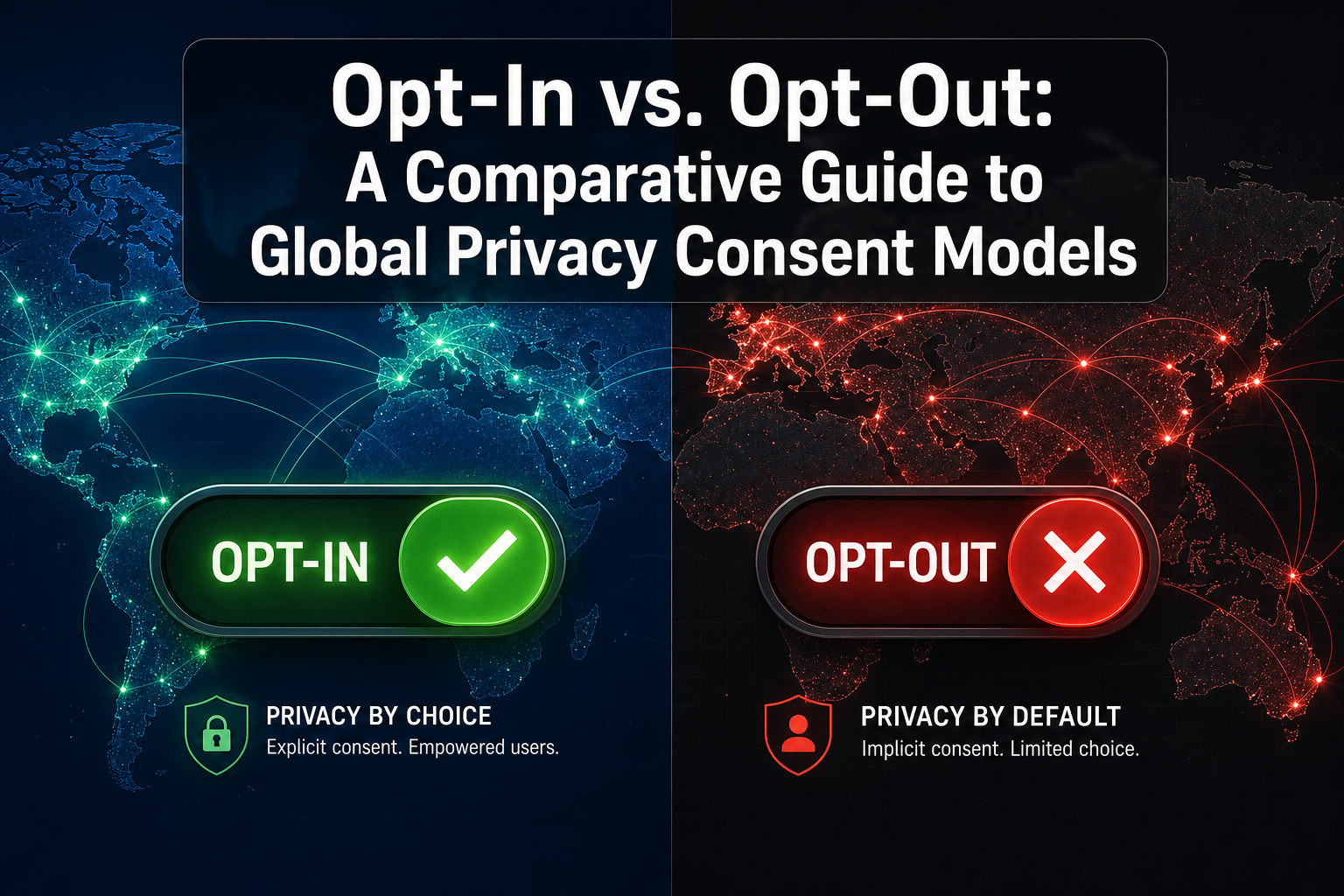
Quick Answer: Opt-in consent requires users to actively agree before their data is collected or processed, while opt-out consent collects data by default unless a user explicitly objects. The right model depends on your jurisdiction, data type, and risk tolerance, but the global regulatory trend is firmly toward opt-in as the higher standard.
Key Takeaways
- Opt-in consent is mandatory under the EU's GDPR and is increasingly adopted by over 137 countries with data protection laws [1]
- The United States primarily uses opt-out frameworks, most notably under the California Consumer Privacy Act (CCPA) [2]
- Opt-out models achieve higher participation rates (avg. 96.8%) but introduce greater consent bias compared to opt-in models (avg. 84% consent rate) [5]
- Dark patterns in opt-out processes actively undermine users' ability to refuse data collection, raising serious compliance risk [4]
- Some advertisers continue processing data even after users opt out, exposing businesses to enforcement liability [7]
- Universal Opt-Out Mechanisms (UOOMs) are emerging as a browser-level signal that businesses must honor under several state laws [6]
- Switching from opt-out to opt-in is technically feasible but requires a full consent architecture rebuild
- Cookies and email marketing consent follow different rules and cannot always be governed by the same consent model
- Generative AI is creating new pressure for granular, context-specific opt-in consent frameworks [8]
- Businesses operating across multiple jurisdictions need layered consent strategies, not a single global default
What Is the Difference Between Opt-In and Opt-Out Consent Models
Opt-in consent means no data collection occurs until a user takes a deliberate affirmative action, clicking "Accept," checking a box, or submitting a form. Opt-out consent means data collection begins automatically, and users must actively stop it. These two models represent fundamentally different assumptions about user intent: opt-in assumes refusal by default; opt-out assumes permission by default.
The practical implications are significant:
| Feature | Opt-In | Opt-Out |
|---|---|---|
| Default state | No consent | Consent assumed |
| User action required | Yes, to permit | Yes, to refuse |
| Data quality | Higher (less bias) | Lower (consent bias) |
| Participation rate | Lower (~84%) | Higher (~96.8%) |
| Regulatory preference | GDPR, LGPD, PIPEDA | CCPA, CAN-SPAM |
| Privacy protection level | Stronger | Weaker |
Common mistake: Many businesses conflate "soft opt-in" (pre-ticked boxes) with genuine opt-in consent. Under GDPR, pre-ticked boxes are explicitly invalid. Silence or inaction never constitutes consent.
Which Countries Require Opt-In vs. Opt-Out for Privacy
Jurisdiction determines your consent model. As of 2026, over 137 countries have enacted data protection laws, and a growing majority align with GDPR's opt-in standard [1]. The divide largely follows a EU-vs-US fault line, but the picture is more nuanced than that.
Opt-in required (explicit consent):
- European Union (GDPR)
- Brazil (LGPD)
- Canada (PIPEDA, and the forthcoming Bill C-27)
- South Korea (PIPA)
- Japan (APPI, amended)
- India (DPDP Act, 2023)
Opt-out permitted (data collected by default):
- United States (federal baseline; CCPA, VCDPA, and similar state laws use opt-out for most data categories) [2]
- Australia (Privacy Act, though under active reform)
- Mexico (LFPDPPP, with some opt-in carve-outs for sensitive data)
Edge case: Even in opt-out jurisdictions, certain data categories require opt-in. Under CCPA, sharing sensitive personal information (health, precise geolocation, financial data) triggers stricter opt-in-style requirements. Never assume a single model covers all data types in any jurisdiction.
Why Is Opt-In Better for Privacy Than Opt-Out
Opt-in consent is stronger for privacy because it requires genuine, informed, and freely given agreement before any data processing begins. This eliminates the structural coercion built into opt-out systems, where user inertia is treated as consent.
Key reasons opt-in provides superior privacy protection:
- No default data collection: Users who never engage with a consent interface are simply not tracked
- Reduced consent bias: Research confirms opt-in procedures produce higher-quality, less biased consent datasets [5]
- Harder to manipulate: Dark patterns (confusing language, hidden opt-out links, misleading button colors) are far less effective when users must actively affirm consent [4]
- Audit trail: Opt-in systems generate timestamped consent records, which are essential for regulatory audits
A 2022 study found that some advertisers continued collecting and processing user data even after opt-out signals were sent, demonstrating that opt-out enforcement is structurally weaker [7]. Opt-in models shift the burden of proof onto the business, not the user.
How Does GDPR Use Opt-In Consent
Under GDPR, consent must be freely given, specific, informed, and unambiguous, and it must be demonstrated by a clear affirmative act. This is the legal definition of opt-in. Article 7 of GDPR also requires that consent be as easy to withdraw as it is to give.
GDPR's opt-in requirements in practice:
- No pre-ticked boxes or bundled consent
- Separate consent for each processing purpose (analytics, marketing, profiling)
- Plain-language explanation of what data is collected and why
- Documented proof of when and how consent was obtained
- Withdrawal mechanism must be prominently accessible at all times
Decision rule: If your website serves EU residents, even if your business is based outside the EU, GDPR's opt-in standard applies to you. The regulation's territorial scope is determined by where users are located, not where the business is incorporated.
What Are the Downsides of Opt-Out Consent
Opt-out consent models carry significant legal, reputational, and data quality risks. While they produce higher participation rates, that participation is often not genuinely voluntary.
Primary downsides:
- Enforcement failure: Studies show some businesses continue processing data even after opt-out signals are received [7]
- Dark patterns: Research from 2024 documented widespread use of deceptive design in opt-out flows, making it deliberately difficult for users to refuse [4]
- Regulatory exposure: As more jurisdictions shift toward opt-in standards, businesses built on opt-out architectures face costly retrofits
- Consent bias: Higher participation in opt-out systems often reflects inertia, not genuine agreement, which can skew data quality [5]
- Reputational risk: Users who discover their data was collected without explicit consent report significantly lower brand trust
A 2024 study also found that many websites implement consent mechanisms so complex that they fail to accurately capture users' actual opt-out choices, creating both privacy violations and compliance liability [3].
Is Opt-In or Opt-Out Better for Business Conversion
Opt-out models typically yield higher data volumes and larger marketing lists in the short term, but opt-in models tend to produce higher-quality leads and stronger long-term engagement. The right answer depends on what "conversion" means for your business.
- Email marketing: Opt-in lists consistently show higher open rates, lower unsubscribe rates, and better deliverability scores because recipients actively chose to receive communications
- Ad targeting: Opt-out data pools are larger but noisier; opt-in consent signals are smaller but more reliable for personalization
- Health and research data: Opt-in consent rates average 84% vs. 96.8% for opt-out, but opt-in data introduces less bias, making it more scientifically valid [5]
Choose opt-in if your business model depends on trust, long-term customer relationships, or regulated data categories. Choose opt-out (where legally permitted) if you need maximum reach in low-sensitivity contexts and have robust mechanisms to honor withdrawal requests promptly.
How Do I Implement Opt-In Consent on My Website
Implementing opt-in consent requires a Consent Management Platform (CMP) that captures, stores, and communicates user preferences to all downstream data processors. A properly configured CMP is the technical backbone of GDPR and similar compliance.
Step-by-step implementation checklist:
- Audit your data flows, identify every cookie, pixel, and third-party script on your site
- Categorize processing purposes, analytics, marketing, functional, strictly necessary
- Deploy a CMP, a tool like Biscotti CMP can handle consent collection, storage, and signal transmission across your tech stack
- Block scripts by default, no third-party scripts should fire until consent is granted for that category
- Design a compliant consent banner, clear language, equal prominence for accept/reject options, no dark patterns
- Store consent records, timestamp, user ID (anonymized), consent version, and preferences granted
- Enable withdrawal, provide an accessible link (e.g., "Manage Cookie Preferences") on every page
- Test across devices, consent flows must work correctly on mobile, tablet, and desktop
Common mistake: Implementing a consent banner that blocks cookies visually but still fires tracking scripts in the background. This is a technical misconfiguration that creates significant GDPR liability.
Can I Switch from Opt-Out to Opt-In Consent
Yes, switching from opt-out to opt-in is possible, but it requires invalidating all previously collected opt-out-based consent records and re-obtaining explicit consent from your existing user base. This is not a configuration change, it's an architectural rebuild.
Key steps when transitioning:
- Purge or quarantine all data collected under the old opt-out model for processing purposes that now require opt-in
- Send re-consent campaigns to existing subscribers or users (email, in-app notification)
- Update your Privacy Policy and cookie policy to reflect the new consent model
- Reconfigure your CMP to block all non-essential data collection until affirmative consent is received
- Expect an initial reduction in addressable audience size, this is normal and legally necessary
Edge case: Data collected under a lawful opt-out regime in a jurisdiction where opt-out was sufficient at the time may not need to be purged retroactively. Consult qualified legal counsel before making that determination, as it depends on the specific regulation and data type.
What Happens If Someone Doesn't Opt In or Opt Out
If a user neither opts in nor opts out, the default state of your consent model determines what happens. Under opt-in frameworks (GDPR), silence means no consent, no non-essential data collection may occur. Under opt-out frameworks, silence is typically treated as implicit permission.
Practical implications:
- GDPR context: A user who dismisses a consent banner without clicking "Accept" has not consented. Only strictly necessary cookies (session management, security) may be set
- CCPA context: A user who ignores an opt-out notice is presumed to have consented to data sale/sharing under the default opt-out model
- Email marketing: Under CAN-SPAM (US), silence permits continued sending; under CASL (Canada) or GDPR, silence means no permission to send marketing emails
Decision rule: If you operate under GDPR or similar opt-in laws, design your system to treat non-response as a "no." Never interpret inaction as consent.
Do I Need Different Consent Models for Different Countries
Yes. Businesses with a global user base cannot apply a single consent model uniformly across all jurisdictions. The legal requirements differ materially between regions, and applying the most permissive standard globally creates regulatory exposure in stricter jurisdictions.
A practical approach:
- Use geolocation or IP-based detection to serve jurisdiction-appropriate consent experiences
- Apply GDPR-standard opt-in to EU/EEA users regardless of where your servers are located
- Apply CCPA opt-out rights to California residents (and equivalent state laws for Virginia, Colorado, etc.)
- Apply LGPD opt-in requirements for Brazilian users
- Default to the strictest applicable standard when jurisdiction is ambiguous, this is the safest posture
The global trend is toward stricter opt-in standards even in historically opt-out jurisdictions, making a GDPR-aligned default increasingly practical as a long-term strategy [9].
What About Opt-In Consent for Cookies vs. Email Marketing
Cookies and email marketing are governed by different legal frameworks and require separate consent mechanisms, even though both involve user data. Bundling them into a single consent action is a compliance error under GDPR.
Cookie consent:
- Governed by ePrivacy Directive (EU) and GDPR
- Requires granular opt-in per cookie category (analytics, marketing, functional)
- Consent must be obtained before non-essential cookies are set
- Must be re-obtained if cookie purposes change
Email marketing consent:
- Governed by GDPR (EU), CAN-SPAM (US), CASL (Canada), and equivalent laws
- Requires a clear affirmative action (ticking a box, submitting a form), not bundled with terms acceptance
- Must include an unsubscribe mechanism in every communication
- Consent records must be retained and producible on request
Common mistake: Using a cookie consent banner to also capture email marketing consent. These are separate processing purposes requiring separate consent captures under GDPR Article 7.
Universal Opt-Out Mechanisms and Emerging Consent Signals
Universal Opt-Out Mechanisms (UOOMs) allow users to signal their opt-out preferences at the browser or device level, automatically applying across multiple websites without requiring per-site action. Several US state privacy laws now require businesses to honor these signals [6].
The Global Privacy Control (GPC) is the most widely recognized UOOM. When a user enables GPC in their browser, it sends an HTTP header to websites indicating the user's opt-out preference. Under the CCPA and several other state laws, businesses must treat this signal as a valid opt-out of data sale and sharing.
For businesses: Honoring UOOMs requires technical integration at the server or tag management level, a cookie banner alone is insufficient. CMPs that support automatic UOOM detection and response are essential for US-based compliance in 2026.
Common Mistakes Companies Make with Opt-In Consent
The most damaging mistakes are technical, not legal, systems that appear compliant but fail to actually block data collection before consent is granted. Regulators increasingly use technical audits, not just document reviews, to assess compliance.
Top mistakes to avoid:
- Firing scripts before consent: Third-party analytics or ad pixels loading on page render, before the user interacts with the consent banner
- Asymmetric design: "Accept All" button is large and prominent; "Reject All" is hidden in a secondary menu or requires multiple clicks [4]
- Consent version mismatch: Updating your Privacy Policy or adding new data processors without re-obtaining consent
- No withdrawal mechanism: Failing to provide an accessible, always-available way to change or revoke consent preferences
- Conflating legitimate interest with consent: Using "legitimate interest" as a legal basis for processing that actually requires consent under GDPR
- Ignoring mobile: Consent banners that are technically compliant on desktop but obscure or non-functional on mobile
Conclusion
The debate captured in any serious Opt-In vs. Opt-Out: A Comparative Guide to Global Privacy Consent Models analysis is not merely academic, it has direct consequences for regulatory exposure, user trust, and data quality. The global regulatory trajectory is clear: opt-in is becoming the default standard, and businesses that build their data architectures around opt-out models are increasingly operating against the grain of both law and user expectation.
Actionable next steps for 2026:
- Audit your current consent model against every jurisdiction where you have users, not just where you're incorporated
- Deploy a technically sound CMP, such as Biscotti CMP, that blocks non-essential scripts before consent, stores records, and supports UOOM signals
- Separate your cookie and email marketing consent flows into distinct, purpose-specific mechanisms
- Review your consent banner design for dark patterns, asymmetric button sizing, misleading language, or hidden reject options
- Plan for re-consent campaigns if you're transitioning from opt-out to opt-in or adding new data processing purposes
- Monitor emerging frameworks for generative AI consent, which is moving toward granular opt-in requirements [8]
The businesses that treat consent architecture as a strategic asset, rather than a compliance checkbox, will be better positioned as privacy regulation continues to tighten globally [9].
FAQ
What is the simplest definition of opt-in vs. opt-out consent? Opt-in means "no data collection until the user says yes." Opt-out means "data collection proceeds unless the user says no." The default state is the key difference.
Does GDPR require opt-in for all data processing? No. GDPR has six legal bases for processing, of which consent (opt-in) is one. Others include contract performance, legal obligation, and legitimate interest. However, for marketing and non-essential cookies, consent is typically the required basis.
Is a pre-ticked checkbox valid opt-in consent under GDPR? No. GDPR explicitly requires a clear affirmative act. Pre-ticked boxes, silence, and inaction do not constitute valid consent.
What is the Global Privacy Control (GPC)? GPC is a browser-level signal that communicates a user's opt-out preference to websites automatically. Several US state laws, including CCPA, require businesses to honor it as a valid opt-out.
Can I use legitimate interest instead of consent to avoid opt-in requirements? Legitimate interest is a valid legal basis under GDPR for some processing activities, but it cannot be used as a workaround for marketing, profiling, or non-essential cookie placement where consent is the appropriate basis.
What happens if I ignore a user's opt-out request? Under CCPA and GDPR, failing to honor opt-out or withdrawal requests can result in regulatory fines, enforcement actions, and private right of action in some jurisdictions. Research also shows some advertisers continue processing after opt-out, which is a documented compliance failure [7].
Do I need a CMP if I only use Google Analytics? Yes, if you serve EU users. Google Analytics sets non-essential cookies that require prior opt-in consent under GDPR and the ePrivacy Directive. A CMP is required to block the Analytics script until consent is granted.
How long must I retain consent records? GDPR does not specify an exact retention period, but records must be kept long enough to demonstrate compliance if challenged. Industry practice is to retain consent records for the duration of the processing relationship plus a reasonable buffer (often 3-5 years).
Is opt-in consent required for B2B email marketing? It depends on jurisdiction. Under GDPR, B2B email marketing to individual business email addresses (as opposed to generic role addresses) typically requires consent. Under CAN-SPAM, no prior consent is required but opt-out must be honored.
What's the difference between opt-in and double opt-in for email? Single opt-in captures consent once (e.g., form submission). Double opt-in adds a confirmation email step, requiring the user to verify their address and intent. Double opt-in produces cleaner lists and stronger consent evidence, and is recommended for GDPR compliance.
References
[1] Opt In Vs Opt Out The Complete Compliance Guide To Global Consent Frameworks - https://compliancehub.wiki/opt-in-vs-opt-out-the-complete-compliance-guide-to-global-consent-frameworks/?utm_source=openai
[2] Role Consent Data Privacy Eu Versus Usa - https://www.americanbar.org/groups/international_law/resources/international-lawyer/59-1/role-consent-data-privacy-eu-versus-usa/?utm_source=openai
[3] arxiv (2024) - https://arxiv.org/abs/2309.00776?utm_source=openai
[4] arxiv (2024) - https://arxiv.org/abs/2409.09222?utm_source=openai
[5] pubmed.ncbi.nlm.nih.gov - https://pubmed.ncbi.nlm.nih.gov/36853745/?utm_source=openai
[6] Navigating Privacy Understanding Consent And Universal Opt Out Methods - https://www.datagrail.io/blog/data-privacy/navigating-privacy-understanding-consent-and-universal-opt-out-methods/?utm_source=openai
[7] arxiv (2022) - https://arxiv.org/abs/2202.00885?utm_source=openai
[8] arxiv (2026) - https://arxiv.org/abs/2604.09413?utm_source=openai
[9] Opt In Vs Opt Out Consent Explained For Data Privacy - https://www.clym.io/blog/opt-in-vs-opt-out-consent-explained-for-data-privacy?utm_source=openai