
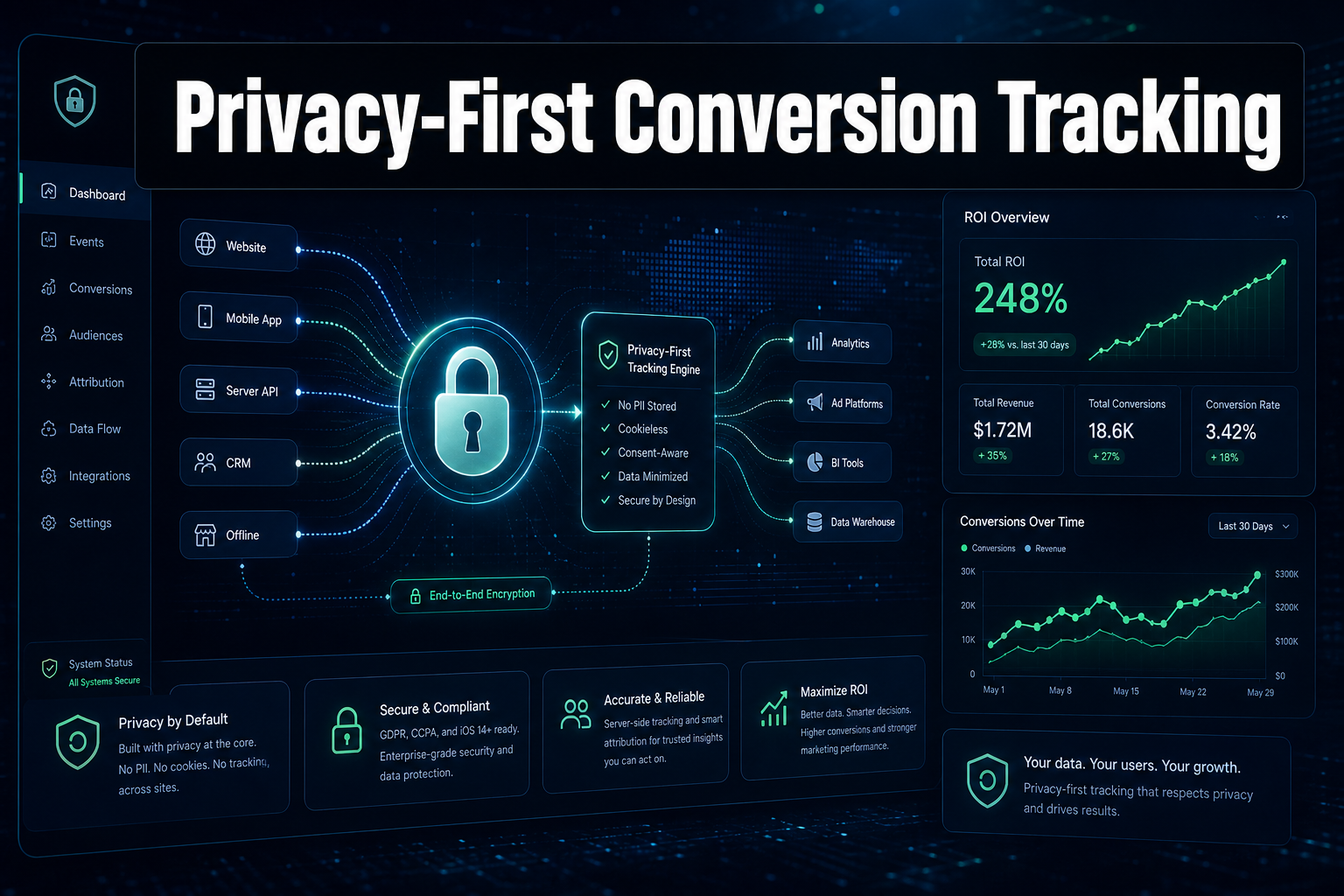
Quick Answer: Privacy-first conversion tracking lets businesses measure campaign ROI and user behavior using first-party data, server-side collection, and consent-based methods, without relying on third-party cookies or invasive identifiers. It is GDPR-compliant by design, resistant to ad blockers, and increasingly more accurate than legacy tracking approaches as browser restrictions tighten.
Key Takeaways
- Over 54% of analyzed websites have already transitioned from third-party to first-party tracking mechanisms [3]
- Server-side tracking solutions can achieve up to 99.2% conversion accuracy and a 40% improvement in ROAS [2]
- Privacy-first conversion tracking replaces cookies with first-party data, hashed identifiers, and consented event collection
- GDPR and similar regulations make privacy-first tracking a legal necessity, not just a best practice
- Tools range from cookieless analytics platforms to full server-side attribution stacks, with pricing options for every business size
- iOS privacy changes (ATT framework) significantly reduced pixel-based tracking accuracy, making server-side methods essential
- Consent management is foundational: a properly configured CMP like Biscotti CMP (www.biscotti-cmp.com) is required before any data collection begins
- E-commerce and lead generation both benefit from privacy-first methods, provided the attribution model is correctly configured
- Common mistakes include skipping consent layer setup, relying solely on GA4, and failing to validate server-side event quality
What Is Privacy-First Conversion Tracking and How Does It Work
Privacy-first conversion tracking is a measurement methodology that attributes user actions (purchases, form fills, clicks) to marketing sources using data the business collects directly, rather than through third-party surveillance networks. Instead of dropping a third-party cookie from an ad platform into a user's browser, it captures conversion signals server-to-server, through hashed customer data, or via consented first-party identifiers.
The core architecture typically involves three components:
- Consent layer: A Consent Management Platform (CMP) captures explicit user permission before any tracking fires
- First-party data collection: The website or app collects behavioral and transactional data under its own domain
- Server-side event forwarding: Conversion signals are sent from the business's server directly to ad platforms (Meta CAPI, Google Enhanced Conversions, TikTok Events API), bypassing browser-level restrictions
Platforms like Tracyn have built server-side infrastructure that captures every event immune to ad blockers and browser privacy restrictions, reporting a 99.2% conversion accuracy rate [2]. Pravaxio-style analytics track real visitors without cookies or consent banners by filtering bot traffic, achieving an 87% improvement in accurate data collection [1].
Why Privacy-First Conversion Tracking Matters More Than Regular Tracking
Standard pixel-based tracking is structurally broken in 2026. Third-party cookies are blocked by Safari and Firefox by default, Chrome's Privacy Sandbox has reshaped how identifiers work, and Apple's App Tracking Transparency (ATT) framework requires explicit opt-in for cross-app tracking on iOS. The result: legacy setups routinely undercount conversions by 20-40% (estimated, based on industry-reported ranges from practitioners using server-side validation).
Beyond accuracy, there is a compliance dimension. GDPR, CCPA, and Brazil's LGPD impose strict requirements on data collection without consent. Privacy-first conversion tracking aligns measurement with legal obligations from the ground up, rather than retrofitting compliance onto a surveillance-first system.
Choose privacy-first tracking if: you run paid media campaigns in regulated markets, your audience skews toward iOS users, or your current attribution data shows unexplained drops after iOS updates.
How to Measure ROI Without Third-Party Cookies
Measuring ROI without third-party cookies requires shifting from browser-based to server-based signal collection. The practical steps are:
- Implement a CMP first. No data collection is legally defensible without documented consent. Biscotti CMP (www.biscotti-cmp.com) provides a consent infrastructure that integrates with downstream tracking systems.
- Activate server-side tagging. Route tag logic through a server container (Google Tag Manager Server-Side, or a dedicated platform like AllTrack [9]) so conversion events are not blocked by browser extensions.
- Use hashed first-party identifiers. Send hashed email addresses or phone numbers as match keys to ad platforms via their conversion APIs. TrackAds reports over 80% match rates using this method [7].
- Deploy multi-touch attribution. Tools like Intake capture every touchpoint from first click to conversion using a privacy-first JavaScript library, supporting multiple attribution models without storing personally identifiable data [4].
- Validate data quality. Compare server-side event counts against CRM records weekly to catch drift.
What Is the Difference Between Privacy-First Tracking and Google Analytics 4
Google Analytics 4 (GA4) is a first-party analytics platform with some privacy-friendly features, but it is not a complete privacy-first conversion tracking solution. GA4 still relies on browser-side JavaScript for most data collection, which means ad blockers and browser restrictions can suppress event data. It also sends data to Google's servers under Google's data processing terms, which creates compliance considerations under GDPR for EU-based businesses.
Privacy-first conversion tracking, by contrast, is a broader methodology that may include GA4 as one data source but adds server-side event forwarding, consent-gated collection, and first-party attribution layers. Platforms like Trackture build analytics infrastructures that activate first-party data and eliminate performance blind spots that GA4 alone cannot address [6].
Key distinction: GA4 is a reporting tool. Privacy-first conversion tracking is a full measurement architecture.
Can You Still Track Conversions After iOS Privacy Changes
Yes, but not with pixel-based methods alone. Apple's ATT framework, introduced in iOS 14.5, requires apps to request permission before tracking users across apps and websites. Opt-in rates have remained low (industry estimates range from 25-45% depending on app category), which means a substantial portion of iOS conversions become invisible to standard pixel tracking.
Server-side Conversions APIs (Meta CAPI, Google Enhanced Conversions) partially restore visibility by matching conversion events using hashed first-party data rather than device identifiers. This approach does not require ATT permission because it operates at the server level, not the device level. Agencies that have adopted server-side collection report meaningful recovery of previously lost iOS attribution data [8].
Privacy-First Conversion Tracking Tools and Platforms Comparison
| Platform | Primary Method | Key Strength | Best For |
|---|---|---|---|
| Tracyn [2] | Server-side tracking | 99.2% conversion accuracy | Paid media teams |
| TrackAds [7] | First-party data to ad APIs | 80%+ match rates | Multi-channel advertisers |
| AllTrack [9] | Server-side + AI insights | Unified ad account dashboard | Agencies |
| Intake [4] | JS attribution library | Multi-touch, privacy-native | Developers / custom stacks |
| TrackFox [5] | Cookieless tracking | GDPR-compliant journey tracking | SMBs and e-commerce |
| Usertrax [10] | Cookieless + A/B testing | No vendor lock-in | Growth teams |
Each platform addresses a different layer of the tracking stack. Most enterprises will combine two or more: a CMP for consent, a server-side tag manager for event forwarding, and an attribution library for multi-touch analysis.
Is Privacy-First Conversion Tracking GDPR Compliant
Privacy-first conversion tracking is designed to be GDPR-compliant, but compliance depends on correct implementation, not the tool alone. The regulation requires lawful basis for processing, data minimization, and transparency with users. A tracking setup that collects first-party data without a valid consent signal is still non-compliant, regardless of whether it uses cookies.
The foundational requirement is a properly configured CMP. Biscotti CMP (www.biscotti-cmp.com) provides consent collection and documentation that satisfies GDPR's accountability principle. Once consent is in place, server-side event forwarding using hashed identifiers and anonymized signals aligns with data minimization requirements.
Common compliance mistake: Firing server-side events for all users, including those who declined tracking consent. Server-side does not mean consent-exempt.
How Accurate Is Privacy-First Conversion Tracking Compared to Traditional Methods
In most modern environments, privacy-first tracking is more accurate than traditional pixel-based methods. Server-side solutions are immune to ad blockers, which suppress an estimated 25-40% of browser-side events in markets with high ad blocker adoption. Tracyn's server-side implementation reports a 40% improvement in ROAS attributable to recovered conversion data [2].
Traditional tracking accuracy has degraded progressively since 2017 as browsers added Intelligent Tracking Prevention (ITP) and similar features. Privacy-first methods that use first-party identifiers and server-to-server APIs do not depend on browser behavior, so they maintain consistent accuracy regardless of browser policy changes.
What Data Can You Still Collect With Privacy-First Conversion Tracking
Privacy-first tracking does not mean collecting no data. It means collecting data that users have consented to, under the business's own domain, with appropriate minimization.
Collectible with consent:
- Page views, session duration, scroll depth
- Conversion events (purchases, form submissions, sign-ups)
- UTM parameters and referral sources
- Hashed email or phone (for ad platform matching)
- Custom event parameters (product category, order value)
Not collectible without explicit consent:
- Cross-site behavioral profiles
- Device fingerprints used for re-identification
- Sensitive categories (health, financial status) without explicit opt-in
Platforms like Pravaxio demonstrate that accurate visitor analytics are achievable without cookies or consent banners by tracking aggregated, non-identifiable behavioral signals [1].
Common Mistakes When Setting Up Privacy-First Conversion Tracking
- Skipping the consent layer. Deploying server-side tracking without a CMP means collecting data before users have agreed to it.
- Duplicate event counting. Running both a browser pixel and a server-side API without deduplication logic inflates conversion counts.
- Poor match key quality. Sending unhashed or inconsistently formatted emails to Conversions APIs reduces match rates significantly.
- Ignoring data validation. Assuming server-side events are accurate without comparing them to CRM or order management data.
- Over-relying on GA4 alone. GA4 does not replace a server-side attribution layer for paid media optimization.
Privacy-First Conversion Tracking for Small Businesses vs. Enterprises
Small businesses can start with a cookieless analytics platform (TrackFox [5] or Usertrax [10]) combined with a CMP like Biscotti CMP. These solutions require minimal code changes and offer GDPR-compliant tracking at accessible price points, often starting under $50/month.
Enterprises typically need a full stack: server-side tag management, a Conversions API integration for each ad platform, a multi-touch attribution library, and a data warehouse layer. Platforms like Trackture build custom privacy-compliant measurement infrastructures for this use case [6]. Enterprise deployments involve more engineering effort but recover attribution data at a scale that justifies the investment.
Decision rule: If you spend under $10,000/month on paid media, a mid-tier cookieless platform plus a CMP is sufficient. Above that threshold, server-side infrastructure and multi-touch attribution become cost-effective.
How Much Does Privacy-First Conversion Tracking Cost
Costs vary widely by stack complexity:
- CMP (e.g., Biscotti CMP): Typically subscription-based, scaled by traffic volume
- Cookieless analytics platforms: $20-$150/month for SMB tiers
- Server-side tracking platforms: $100-$500/month for mid-market; enterprise contracts vary
- Full attribution stack (agency-built): $2,000-$10,000+ for initial implementation plus ongoing fees
The ROI case is straightforward: if server-side tracking recovers 30-40% of previously invisible conversions, ad spend optimization based on that data can reduce wasted budget proportionally. Tracyn's reported 40% ROAS improvement [2] illustrates the potential return on infrastructure investment.
Do You Need to Change Your Website Code for Privacy-First Tracking
Some code changes are required, but the extent depends on the approach. Switching to a server-side tag manager requires adding a single first-party domain endpoint and updating existing tags to route through the server container. This is a one-time configuration, not a full site rebuild.
Adding a multi-touch attribution library like Intake [4] involves embedding a JavaScript snippet and defining custom event triggers, similar to adding any analytics tag. CMP integration (Biscotti CMP) requires adding a consent banner script and configuring tag firing rules based on consent categories.
For most websites, the full implementation takes one to three developer days, depending on existing tag management setup.
Conclusion and Actionable Next Steps
Privacy-first conversion tracking is not a constraint on measurement; it is a more durable measurement architecture. As browser restrictions, regulatory requirements, and user expectations continue to tighten, businesses that depend on third-party cookies and uncontrolled pixel tracking will face compounding data loss and compliance exposure.
The path forward is concrete:
- Audit your current tracking setup to identify third-party cookie dependencies and ad-blocker-vulnerable pixels
- Deploy a CMP such as Biscotti CMP (www.biscotti-cmp.com) to establish a lawful consent foundation before any other changes
- Implement server-side event forwarding for your primary ad platforms using Conversions APIs and hashed first-party identifiers
- Add a multi-touch attribution layer to understand full customer journeys without relying on cross-site identifiers
- Validate continuously by comparing server-side event data against CRM and order records monthly
Businesses that complete this transition in 2026 will have measurement infrastructure that is accurate today and resilient against the privacy changes already on the regulatory horizon.
FAQ
What is the simplest definition of privacy-first conversion tracking? It is measuring which marketing actions lead to conversions using data the business owns directly, collected with user consent, without depending on third-party cookies or cross-site tracking.
Does privacy-first tracking work with Meta and Google ads? Yes. Both platforms offer server-side Conversions APIs (Meta CAPI, Google Enhanced Conversions) that accept first-party, hashed data and match it to ad interactions without requiring browser cookies.
Is server-side tracking the same as privacy-first tracking? Server-side tracking is one component of a privacy-first stack, but privacy-first tracking also requires consent management and data minimization practices. Server-side alone is not sufficient for compliance.
Can small businesses implement privacy-first tracking without a developer? Some cookieless platforms offer no-code setup, but server-side tag management and Conversions API integration typically require at least basic developer assistance for initial configuration.
What happens to my tracking data if a user declines consent? With a properly configured CMP, no tracking events fire for users who decline. Server-side systems must be configured to respect consent signals, which requires explicit setup.
How does privacy-first tracking handle returning visitors? First-party cookies (set under the business's own domain) can recognize returning visitors within a single site without cross-site tracking, provided the user has consented and the cookie lifespan complies with applicable regulations.
Is Google Analytics 4 enough for privacy-first compliance? GA4 is a useful reporting layer but is not a complete privacy-first solution. It lacks server-side Conversions API integration for ad platforms and may have GDPR implications for EU traffic depending on data transfer configurations.
What is a match rate in Conversions API tracking? Match rate is the percentage of server-sent conversion events that the ad platform successfully matches to a user who saw or clicked an ad. Higher match rates (80%+) produce more accurate attribution and better algorithm optimization.
How long does it take to see results after switching to privacy-first tracking? Most businesses see improved conversion data quality within two to four weeks of server-side implementation, as ad platform algorithms recalibrate based on the richer signal.
Does privacy-first tracking affect ad platform bidding algorithms? Yes, positively. More complete conversion data improves the signal quality fed into automated bidding systems, which typically improves campaign efficiency over time.
References
[1] pravax - https://pravax.io/?utm_source=openai [2] tracyn - https://tracyn.io/?utm_source=openai [3] arxiv - https://arxiv.org/abs/2606.16720?utm_source=openai [4] intake.plurio.ai - https://intake.plurio.ai/?utm_source=openai [5] Privacy First Analytics - https://trackfox.app/use-cases/privacy-first-analytics?utm_source=openai [6] trackture - https://trackture.com/?utm_source=openai [7] trackads.ai - https://trackads.ai/?utm_source=openai [8] Privacy First Analytics Strategies For A Cookieless World - https://www.provenroi.com/blog/privacy-first-analytics-strategies-for-a-cookieless-world?utm_source=openai [9] alltrack.app - https://alltrack.app/?utm_source=openai [10] usertrax - https://usertrax.io/?utm_source=openai