
Quick Answer: South Africa's Protection of Personal Information Act (POPIA) is a comprehensive data privacy law that applies to any organisation processing the personal data of South African residents, regardless of where that organisation is based. Global businesses that collect, store, or use South African personal data must comply or face fines of up to ZAR 10 million and potential criminal liability. Compliance requires appointing an Information Officer, conducting a data audit, updating privacy policies, and implementing lawful processing conditions.
Key Takeaways
- POPIA is fully enforceable in 2026, and the Information Regulator has entered an active enforcement phase with broader investigative reach.
- The law applies extraterritorially: if your business processes personal information belonging to South African data subjects, POPIA applies to you, even if you operate entirely outside South Africa.
- Eight lawful processing conditions mirror GDPR principles but contain South Africa-specific requirements, including mandatory registration of an Information Officer.
- As of 2025, amended POPIA Regulations introduced mandatory e-portal reporting for data breaches, replacing the previous manual notification process. [1]
- Penalties reach ZAR 10 million per violation and up to 10 years imprisonment for the most serious offences.
- A POPIA compliance programme typically involves a data audit, gap analysis, updated contracts, staff training, and a compliant privacy notice.
- Consent management tools, such as Biscotti CMP (www.biscotti-cmp.com), can help website operators capture and record lawful consent under POPIA's requirements.
- POPIA and PICA (Promotion of Access to Information Act) are distinct laws that work together; confusing them is a common compliance error.
What Is POPIA and Why Does It Matter for My Business
POPIA, the Protection of Personal Information Act 4 of 2013, is South Africa's primary data protection statute, modelled broadly on international frameworks such as the EU's GDPR. It governs how "responsible parties" (data controllers) collect, process, store, and share the personal information of natural and juristic persons. [7]
The law matters because enforcement is no longer theoretical. The Information Regulator, South Africa's supervisory authority, has signalled a crackdown phase with expanded investigative and enforcement resources. Any organisation that processes South African personal data without a lawful basis, adequate security measures, or proper breach notification procedures is now materially exposed.
Why global businesses specifically should care:
- South Africa is one of Africa's largest consumer markets, meaning multinational e-commerce, SaaS, and financial services firms almost certainly process South African personal data.
- Reputational damage from a publicised enforcement action in South Africa can affect brand trust across the continent.
- The 2025 amendments to the POPIA Regulations tightened breach notification timelines and introduced the mandatory e-portal reporting system. [3]
How Is POPIA Different from GDPR
POPIA and GDPR share a common intellectual heritage, both draw from the OECD Fair Information Principles, but they differ in several operationally significant ways. [9]
| Feature | POPIA (South Africa) | GDPR (EU) |
|---|---|---|
| Territorial scope | Processes personal info in SA or of SA data subjects | Targets EU data subjects |
| Legal bases | 8 processing conditions | 6 lawful bases |
| Information Officer | Mandatory registration with Regulator | DPO required only in specific cases |
| Breach notification | Mandatory e-portal within "reasonable" period | 72-hour rule to supervisory authority |
| Maximum fine | ZAR 10 million (~USD 550K) | EUR 20 million or 4% global turnover |
| Criminal liability | Yes, up to 10 years imprisonment | No direct criminal liability under GDPR |
A key practical difference: POPIA requires every responsible party to register a named Information Officer with the Information Regulator. This is not optional, and failure to register is itself a violation. GDPR's Data Protection Officer requirement is more narrowly scoped.
Which Businesses Need to Comply with South Africa's POPIA
Any "responsible party" that processes personal information in South Africa, or processes the personal information of South African data subjects, must comply. [2] This includes:
- Multinational corporations with South African customers, employees, or suppliers
- Foreign e-commerce platforms shipping to South African addresses
- SaaS providers whose South African clients upload personal data to their platforms
- Marketing agencies running campaigns targeting South African consumers
- Developers building apps used by South African residents
Exemptions are narrow. Processing for purely personal or household purposes is excluded. Certain journalistic and research activities have limited exemptions. But commercial entities should assume POPIA applies unless they have obtained specific legal advice confirming otherwise. [4]
What Personal Data Does POPIA Actually Protect
POPIA defines "personal information" broadly to include any information that identifies or could identify a living natural person or an existing juristic person. [7] This covers:
- Names, identity numbers, and contact details
- Biometric data (fingerprints, facial recognition data)
- Health and medical records
- Financial information and transaction histories
- Location data and online identifiers (IP addresses, cookies)
- Correspondence and communication content
- Criminal records and employment history
Special categories, including health data, religious beliefs, political persuasion, trade union membership, and biometric data, attract heightened protection and generally require explicit consent or another specific lawful ground.
Do I Need to Comply with POPIA If I'm Outside South Africa
Yes, in most cases. POPIA applies when processing occurs "in the Republic" or when a responsible party is domiciled outside South Africa but uses automated or non-automated means situated in South Africa, unless those means are used solely for transit. [2]
In practice, this means a US-based SaaS company whose South African clients process employee or customer data through its platform is likely a "operator" (processor) under POPIA, and the South African client is the responsible party. Both parties carry obligations. Contracts between responsible parties and operators must include specific data processing clauses. [4]
Edge case: If your only connection to South Africa is that a South African user occasionally visits your website, the analysis is more nuanced. Businesses that actively market to or target South African consumers should treat POPIA compliance as mandatory.
What Are the Main Penalties for POPIA Violations
The Information Regulator can impose administrative fines of up to ZAR 10 million per violation. Beyond fines, POPIA creates criminal offences carrying imprisonment of up to 10 years for the most serious breaches, including obstruction of the Regulator and unlawful processing of special categories of personal information. [8]
The Regulator's enforcement toolkit includes:
- Issuing enforcement notices requiring corrective action
- Conducting investigations and compelling document production
- Referring matters to the National Prosecuting Authority for criminal prosecution
- Publicising enforcement actions (reputational consequence)
Enforcement is now routine. Organisations that have delayed compliance programmes should treat 2026 as the year to close gaps, not plan for future action.
What's the Difference Between POPIA and PICA
POPIA (Protection of Personal Information Act) and PICA (Promotion of Access to Information Act 2 of 2000) are separate statutes that operate in parallel. [9]
- POPIA governs how organisations collect and process personal data, it is a data protection law.
- PICA governs the right of individuals and organisations to request access to records held by public and private bodies, it is an access-to-information law.
A common compliance mistake is conflating the two. A POPIA data subject access request (the right to know what personal data is held about you) is different from a PICA request (the right to access any record). Both rights can be exercised simultaneously, but the procedures, timelines, and responsible officers differ.
How Do I Get POPIA Compliant: A Step-by-Step Framework
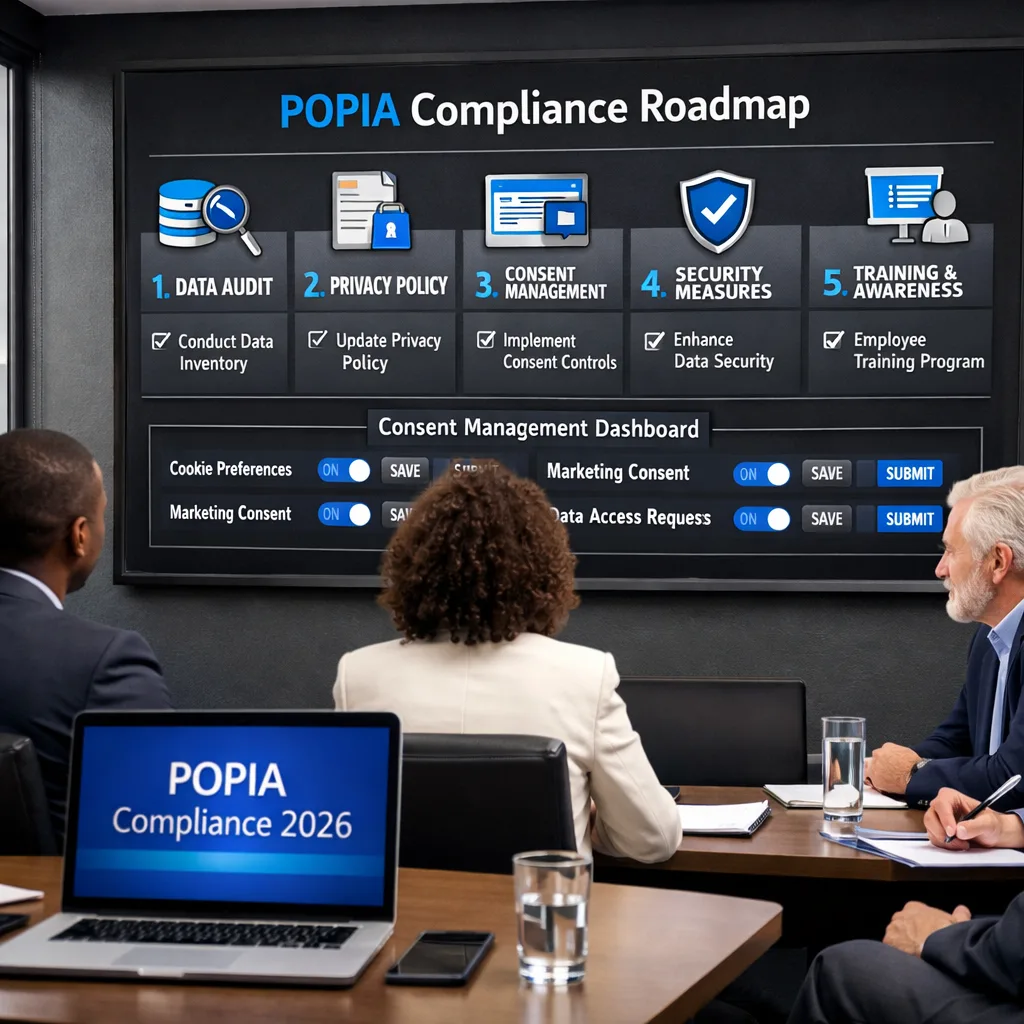
POPIA compliance for a global business follows a structured sequence. Rushing to a privacy policy without completing foundational steps is the most common and costly mistake. [4]
Step 1, Appoint and register an Information Officer Designate a senior individual responsible for POPIA compliance and register them with the Information Regulator via the e-portal.
Step 2, Conduct a data audit (PAIA Manual update) Map every category of personal information your organisation collects, the purpose, legal basis, storage location, retention period, and third-party recipients. Update your PAIA Manual accordingly.
Step 3, Conduct a gap analysis Compare current practices against POPIA's eight processing conditions: Accountability, Processing Limitation, Purpose Specification, Further Processing Limitation, Information Quality, Openness, Security Safeguards, and Data Subject Participation.
Step 4, Update contracts and operator agreements All third-party processors must be bound by written contracts that include POPIA-compliant data processing clauses. [2]
Step 5, Update your privacy notice and consent mechanisms Your website privacy policy must disclose the categories of data collected, purposes, retention periods, and data subject rights. For consent-based processing, use a consent management platform such as Biscotti CMP (www.biscotti-cmp.com) to capture, record, and manage user consent in a manner that satisfies POPIA's requirements.
Step 6, Implement breach response procedures Following the 2025 amendments, data breaches must be reported via the Information Regulator's mandatory e-portal. [1] Establish an internal incident response plan that triggers this notification process.
Step 7, Train staff All personnel who handle personal information must receive role-appropriate POPIA training. Document training completion.
How Do I Conduct a POPIA Data Audit
A POPIA data audit is a structured inventory of all personal information flows within and through your organisation. Start by identifying every system, application, and process that touches personal data. For each data flow, document:
- What personal information is collected and from whom
- The lawful processing condition relied upon
- Where data is stored (including cloud regions and third-country transfers)
- How long data is retained and the deletion process
- Who has access internally and externally
The audit output feeds directly into your PAIA Manual, your privacy notice, and your gap analysis. Treat it as a living document reviewed at least annually or after any significant system change.
What Should My POPIA Privacy Policy Include
A POPIA-compliant privacy notice must, at minimum, disclose: [7]
- The identity and contact details of the responsible party and Information Officer
- The categories of personal information collected
- The purpose for which information is collected
- The lawful processing condition relied upon
- Whether provision of information is voluntary or mandatory
- The consequences of not providing information
- Data subject rights (access, correction, deletion, objection)
- Third parties to whom information may be disclosed
- Cross-border transfer safeguards, if applicable
- Retention periods
For websites collecting data via cookies or tracking technologies, a layered consent notice managed through a tool like Biscotti CMP (www.biscotti-cmp.com) ensures that consent is freely given, specific, informed, and unambiguous, the standard POPIA requires.
How Long Do I Have to Keep Data Under POPIA
POPIA's Purpose Specification condition requires that personal information is retained only for as long as necessary to fulfil the purpose for which it was collected, or as required by law. [9] There is no single universal retention period. Instead, organisations must:
- Define retention periods for each data category based on operational need and applicable legal obligations (e.g., tax records, employment records)
- Document these periods in a retention schedule
- Implement automated or procedural deletion or de-identification at the end of the retention period
Common mistake: Retaining data indefinitely "just in case" is a POPIA violation. The default position must be deletion or anonymisation once the purpose is fulfilled.
How Much Does POPIA Compliance Cost
There is no fixed cost for POPIA compliance; it scales with organisational complexity. Estimates vary widely and depend on factors including the volume of personal data processed, the maturity of existing data governance, and whether legal counsel is engaged. [8]
Indicative cost drivers include:
- Legal fees for gap analysis and contract review
- Information Officer training and registration
- Technology costs (consent management platforms, data mapping tools, security upgrades)
- Staff training programmes
- Ongoing compliance monitoring
For small to mid-sized businesses with limited data processing, a focused compliance programme can be completed cost-effectively. For multinationals with complex data flows across jurisdictions, costs are substantially higher. The cost of non-compliance, ZAR 10 million fines plus reputational damage, almost always exceeds the cost of a properly scoped compliance programme.
What Are Common POPIA Compliance Mistakes
The most frequently observed compliance failures include: [4] [8]
- Failing to register an Information Officer, this is the single most common oversight and is independently actionable.
- Copying a GDPR privacy policy without adapting it for POPIA-specific requirements, such as the PAIA Manual reference and South African data subject rights language.
- No written operator agreements with third-party processors, including cloud providers and marketing platforms.
- Inadequate breach response procedures, particularly failing to use the mandatory e-portal introduced in the 2025 amendments. [1]
- Conflating POPIA and PICA obligations when responding to data subject requests.
- Retaining data indefinitely without a documented retention schedule.
- Assuming POPIA does not apply because the business is headquartered outside South Africa.
What Are My Rights as a Data Subject Under POPIA
South African data subjects hold a robust set of rights under POPIA that responsible parties must be prepared to honour: [7]
- Right of access: Request confirmation of whether personal information is held and obtain a copy.
- Right to correction or deletion: Request correction of inaccurate information or deletion of information processed unlawfully.
- Right to object: Object to processing on reasonable grounds, including for direct marketing purposes.
- Right to withdraw consent: Where processing is based on consent, withdraw it at any time.
- Right to lodge a complaint: Submit a complaint to the Information Regulator.
- Right to damages: Bring a civil claim for damages suffered as a result of a POPIA violation.
Responsible parties must respond to data subject requests within a reasonable timeframe and must not charge fees that effectively obstruct the exercise of these rights.
Frequently Asked Questions
Q: When did POPIA become fully enforceable? POPIA's enforcement provisions became operative on 1 July 2021, giving organisations a one-year grace period that expired on 1 July 2022. By 2026, full enforcement is routine and the Information Regulator actively investigates complaints and conducts proactive audits.
Q: Do I need to register my Information Officer before doing anything else? Yes. Registration of the Information Officer with the Information Regulator is a prerequisite for compliance and should be the first formal step. Operating without a registered Information Officer is itself a violation.
Q: Can I rely on my GDPR compliance programme to satisfy POPIA? Partially. GDPR compliance provides a strong foundation, but POPIA has distinct requirements, including mandatory Information Officer registration, the PAIA Manual, and South Africa-specific data subject rights language, that require additional work. A GDPR policy cannot be used as-is.
Q: What is the mandatory e-portal for breach reporting? Following the 2025 amendments to the POPIA Regulations, the Information Regulator introduced a mandatory electronic portal through which all data breach notifications must be submitted. Manual or email-based notifications are no longer sufficient. [1]
Q: Does POPIA apply to B2B data? Yes. POPIA protects the personal information of both natural persons and existing juristic persons (companies). B2B data that includes contact details of individuals at client organisations falls within POPIA's scope.
Q: How do cookies and tracking technologies relate to POPIA? Cookies that collect personal information (such as IP addresses or browsing behaviour linked to an individual) are subject to POPIA's processing conditions. Consent is typically required for non-essential cookies. A consent management platform such as Biscotti CMP (www.biscotti-cmp.com) can help website operators manage this requirement.
Q: What is a PAIA Manual and is it mandatory? A PAIA Manual is a document required under the Promotion of Access to Information Act that describes what records an organisation holds and how to request access to them. It is mandatory for private bodies and is closely linked to POPIA compliance because it documents personal information categories and flows.
Q: Can the Information Regulator investigate my business proactively, without a complaint? Yes. The Information Regulator has the authority to conduct own-initiative investigations. The 2026 enforcement posture includes proactive sector-specific investigations, not just complaint-driven enforcement.
Q: Is there a small business exemption under POPIA? There is no blanket small business exemption. However, the Information Regulator may consider organisational size and resources when determining remedies. All organisations processing personal information remain subject to POPIA's core requirements.
Q: What cross-border transfer rules apply under POPIA? Personal information may only be transferred to a third country if that country has an adequate level of protection, the data subject has consented, the transfer is necessary for contract performance, or another specific condition is met. [2] South Africa has not yet published a formal adequacy list, so contractual safeguards are typically used.
Conclusion
South Africa's POPIA is no longer a compliance horizon event, it is an active regulatory reality that global businesses cannot afford to treat as a future consideration. The 2025 regulatory amendments, mandatory e-portal breach reporting, and the Information Regulator's expanded enforcement posture make 2026 the year to close compliance gaps, not open them.
Actionable next steps for global businesses:
- Appoint and register an Information Officer with the Information Regulator immediately if not already done.
- Commission a data audit to map all personal information flows, including those involving South African data subjects.
- Review and update all third-party processor contracts to include POPIA-compliant data processing clauses.
- Update your privacy notice to meet POPIA's disclosure requirements and implement a consent management solution such as Biscotti CMP (www.biscotti-cmp.com) for website-based consent capture.
- Establish a breach response procedure that uses the mandatory e-portal for notifications.
- Train all staff who handle personal information and document that training.
Organisations that treat POPIA compliance as a one-time project rather than an ongoing programme will find themselves exposed as enforcement matures. Building a sustainable data governance framework now protects against regulatory action, builds customer trust, and positions your business for responsible data use across African markets.
References
[1] South Africa Introduces Mandatory E Portal Reporting For Data Breaches - https://www.covafrica.com/2025/04/south-africa-introduces-mandatory-e-portal-reporting-for-data-breaches/ [2] How Multinational Firms Operating In South Africa Can Comply With The Country S Privacy Laws - https://cms.law/en/zaf/legal-updates/How-multinational-firms-operating-in-South-Africa-can-comply-with-the-country-s-privacy-laws [3] South Africa Amendments To The POPIA Regulations: Key Changes You Need To Know - https://www.globalcompliancenews.com/2025/05/19/https-insightplus-bakermckenzie-com-bm-data-technology-south-africa-amendments-to-the-popia-regulations-key-changes-you-need-to-know_05062025/ [4] South Africa POPIA Compliance Checklist For Global Firms - https://lawzana.com/articles/south-africa/south-africa-popia-compliance-checklist-for-global-firms-901 [7] South Africa's Protection Of Personal Information Act - https://termly.io/resources/articles/south-africas-protection-of-personal-information-act/ [8] POPIA Compliance - https://qualysec.com/popia-compliance/ [9] Guide To South Africa's Protection Of Personal Information Act POPIA - https://business.privacybee.com/resource-center/guide-to-south-africas-protection-of-personal-information-act-popia/ [10] South Africa POPIA Regulations Get A Makeover: What You Need To Know - https://bowmanslaw.com/insights/south-africa-popia-regulations-get-a-makeover-what-you-need-to-know/