
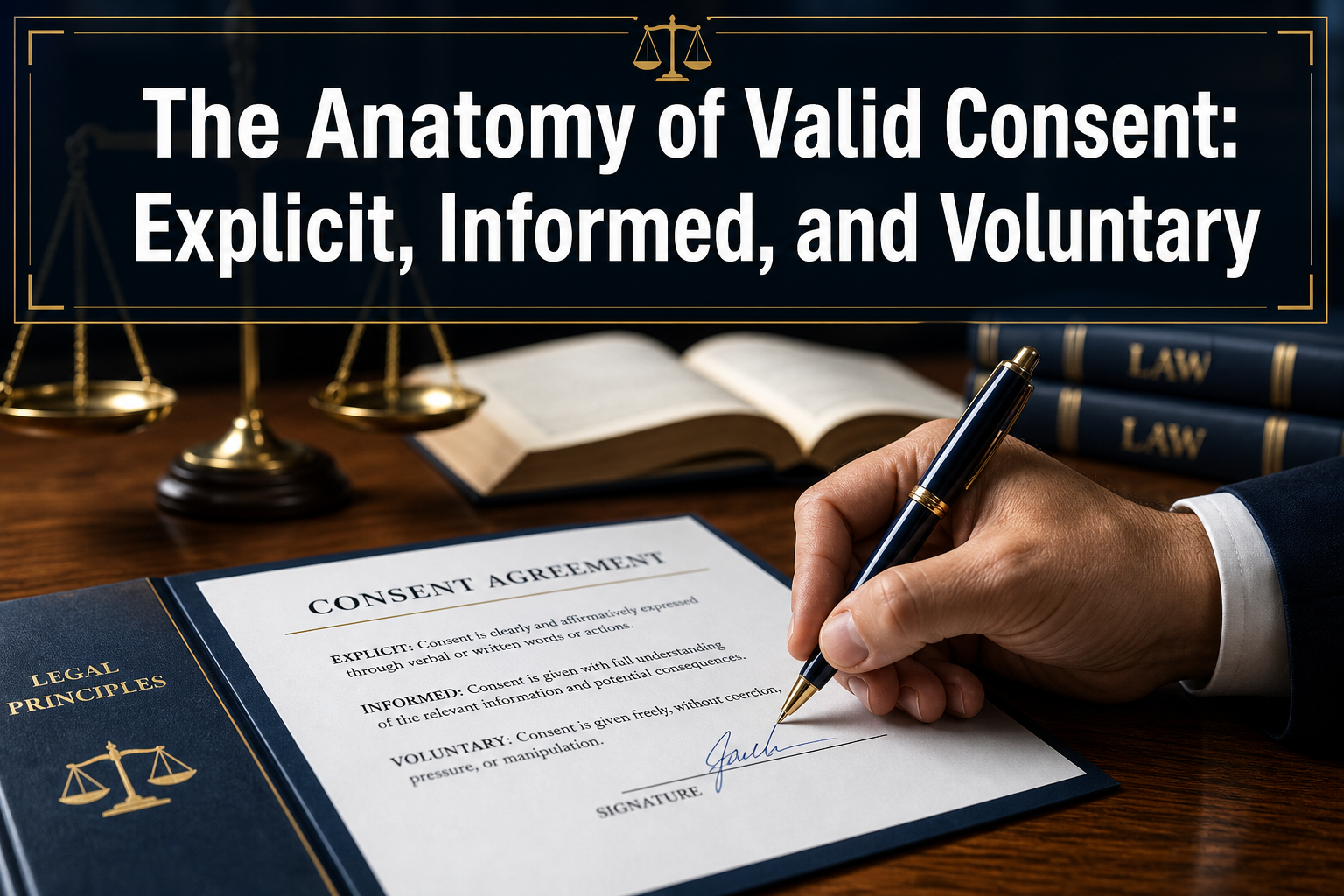
Quick Answer: Valid consent requires three simultaneous conditions: it must be explicitly given, based on sufficient information, and entirely free from coercion or undue pressure. When any one of these pillars collapses, the consent itself becomes legally and ethically defective, regardless of whether a signature was obtained. This applies across medical care, data processing, contracts, and research contexts.
Key Takeaways
- Valid consent is a voluntary, willful agreement given by a person with sufficient mental capacity, free from coercion, fraud, or error [1]
- Explicit consent requires a clear, affirmative act, silence, inaction, or pre-ticked boxes do not qualify [7]
- Informed consent demands that the person receives enough relevant information to make a meaningful decision, not merely a summary [8]
- Voluntariness is destroyed by pressure, manipulation, or power imbalances that leave a person no real alternative [6]
- Consent can be withdrawn at any time; withdrawal must be as easy as giving consent in the first place [7]
- Written consent is not always legally required, but it is the strongest form of documentation available
- Capacity to consent varies by jurisdiction and context; age, cognitive ability, and situational factors all affect legal validity [6]
- Silence is never consent, a person must take a positive action to indicate agreement [7]
- Consent and mere agreement are not identical; consent carries specific legal weight and conditions
- Persons with disabilities retain the right to give valid consent when appropriate support and accommodations are provided
What Does Valid Consent Actually Mean in Legal Terms
Valid consent is a voluntary and willful agreement to another's proposition, requiring sufficient mental capacity and the complete absence of coercion, fraud, or material error [1]. It functions as both a legal defense and a foundational requirement across contract law, tort law, medical practice, and data privacy regulation.
For consent to hold legal weight, four elements must coexist:
- Voluntariness: The person must act freely, without pressure or manipulation
- Capacity: The person must possess the mental and legal ability to decide
- Information: The person must understand what they are agreeing to
- Specificity: The consent must relate to a defined action, not a blanket authorization [6]
Understanding the anatomy of valid consent, explicit, informed, and voluntary, matters because courts and regulators treat defective consent as no consent at all. A signed form obtained through deception, for instance, provides no legal protection.
Difference Between Explicit Consent and Implied Consent
Explicit consent (also called expressed consent) is directly communicated through written or spoken words, leaving no ambiguity about the person's agreement [2]. Implied consent, by contrast, is inferred from a person's conduct, circumstances, or established norms, for example, extending an arm for a routine blood pressure check implies consent to that specific act.
The legal weight of each differs significantly:
| Type | How It's Given | Legal Strength | Common Context |
|---|---|---|---|
| Explicit | Written or spoken affirmation | Highest | Data processing, surgery, contracts |
| Implied | Conduct or context | Moderate | Routine medical exams, social interactions |
| Affirmative | Active opt-in act | High | GDPR-regulated data collection |
| Presumed | Default assumption | Lowest | Emergency medical care |
Key distinction for data privacy professionals: Under the EU's General Data Protection Regulation (GDPR), implied consent is insufficient for processing personal data. The European Commission requires a positive act, clicking a clearly labeled button, for instance, not passive non-objection [7].
What Makes Consent Informed vs Uninformed
Informed consent requires that the person receives clear, complete, and comprehensible information before agreeing, including the nature of the action, its risks, its benefits, available alternatives, and the consequences of refusal [8]. Uninformed consent is consent given in the absence of this disclosure, which renders it legally defective even if the person signed willingly.
The U.S. Food and Drug Administration mandates that no clinical investigator may involve a human subject in research without obtaining legally effective informed consent, which includes providing sufficient opportunity to consider participation [5]. The U.S. Department of Health and Human Services similarly frames informed consent as a communication process, not a paperwork exercise [9].
Three common failures that produce uninformed consent:
- Using technical jargon the person cannot reasonably understand
- Omitting material risks because disclosure might deter agreement
- Providing information immediately before a procedure, leaving no time for reflection
Can Consent Be Valid If Someone Feels Pressured
No. Voluntariness is a non-negotiable component of the anatomy of valid consent: explicit, informed, and voluntary. Consent obtained through coercion, undue influence, threats, or manipulation is void, even if the person ultimately signed or verbally agreed [1].
The challenge is that pressure is not always overt. Subtle coercion, such as a power imbalance between an employer and employee, or a healthcare provider implying that treatment will be withheld without agreement, can invalidate consent just as effectively as an explicit threat.
Decision rule: Consent is suspect whenever the person had no realistic alternative to agreeing. Regulators and courts examine the circumstances surrounding consent, not just the act of signing.
How Do You Prove Someone Gave Informed Consent
Proof of informed consent typically requires documentation showing that the person received relevant information, had the opportunity to ask questions, and then affirmatively agreed [8]. In practice, this means written consent forms, timestamped records of digital opt-ins, audio or video records in high-stakes clinical settings, or signed acknowledgment logs.
For data processors and website owners, the European Commission's guidelines specify that records must demonstrate what information was provided, when consent was given, and through what mechanism, a standard that pre-ticked checkboxes or bundled terms-of-service agreements cannot meet [7].
Practical documentation checklist:
- Record the date, time, and method of consent
- Retain a copy of the information provided at the time of consent
- Log any questions asked and answers given
- Store records for the duration required by applicable law
What Happens If Consent Isn't Voluntary
Non-voluntary consent is legally void. In contract law, this opens the door to claims of duress or undue influence, potentially voiding the entire agreement [1]. In medical contexts, treatment performed without valid consent can constitute battery. In data privacy, processing personal data on the basis of coerced consent exposes organizations to regulatory enforcement and significant fines under frameworks like the GDPR [7].
Beyond legal consequences, invalid consent erodes trust. For enterprises and online marketing agencies, a consent framework that fails the voluntariness test does not just create compliance risk, it damages the relationship with users whose data is being processed.
Does Consent Need to Be in Writing to Be Valid
Written consent is not universally required for legal validity, but it is the most defensible form of evidence. Verbal consent can be legally sufficient in many contexts, including routine medical examinations and informal contracts, provided the other elements of valid consent are present [6].
However, several contexts impose a writing requirement by law or regulation:
- Clinical research under FDA regulations [5]
- Processing of sensitive personal data under GDPR [7]
- Surgical procedures in most healthcare jurisdictions
- Contracts for real estate or transactions above statutory value thresholds
Practical guidance: Even when writing is not legally required, obtaining it protects all parties. For digital environments, a consent management platform such as Biscotti CMP can automate the capture, storage, and audit of consent records, reducing the evidentiary burden significantly.
Can Consent Be Withdrawn After It's Given
Yes. Consent can be withdrawn at any time, and withdrawal must be as straightforward as giving consent in the first place [7]. This principle is especially prominent in data privacy law: under GDPR, a data subject who withdraws consent must not face detriment as a result, and the withdrawal must take effect promptly.
Withdrawal does not automatically undo actions already taken in good faith reliance on valid consent, but it does stop future processing or action. Organizations must design their systems to honor withdrawal requests without unnecessary friction, a requirement that has direct implications for cookie banners, email marketing opt-outs, and research participation.
What Are Common Mistakes People Make About Consent
The most frequent errors in consent practice stem from treating it as a formality rather than a substantive process. Understanding the anatomy of valid consent, explicit, informed, and voluntary, helps identify where these failures occur.
Common mistakes:
- Bundling consent: Requiring agreement to multiple unrelated purposes in a single checkbox [7]
- Assuming silence means yes: Non-response is not consent under any major legal framework [7]
- Using pre-ticked boxes: These fail the affirmative act requirement under GDPR
- Providing information too late: Consent given under time pressure may not be truly voluntary
- Failing to document: Undocumented consent is nearly impossible to prove in a dispute [8]
- Ignoring withdrawal mechanisms: No clear opt-out process undermines the entire consent framework
At What Age Can Someone Legally Give Valid Consent
The age at which a person can give legally valid consent varies by jurisdiction and context. In the United States, the general age of majority for contract consent is 18, though minors may consent to certain medical treatments (such as reproductive health services) at younger ages under specific state laws [6]. Under GDPR, the default age for digital consent is 16, though member states may lower this to 13 [7].
For clinical research, the FDA requires parental or guardian permission for minors, alongside the minor's assent where developmentally appropriate [5].
Edge case: Emancipated minors are generally treated as adults for consent purposes, regardless of age.
Is Silence the Same as Giving Consent
No. Silence is never consent. This is one of the most clearly established principles across legal systems and regulatory frameworks. The European Commission explicitly states that valid consent requires a positive act, a person who does not respond to a request has not agreed to anything [7].
This matters enormously for website owners and developers deploying cookie banners or data collection mechanisms. A banner that continues to load tracking scripts unless a user actively objects does not satisfy the consent standard. The user must take an affirmative step.
What's the Difference Between Consent and Agreement
Consent and agreement overlap but are not interchangeable. Agreement is a broader term covering any mutual assent between parties, including implied or tacit understanding. Consent carries a narrower, more demanding legal meaning: it must be voluntary, informed, specific, and given by a person with capacity [1] [6].
In practice: a person might agree to something through social pressure or incomplete information, but that agreement would not constitute valid legal consent. The distinction matters in litigation, regulatory proceedings, and ethical review processes.
Can Someone With a Disability Give Valid Consent
Yes, in most circumstances. A disability does not automatically remove a person's capacity to consent. Capacity is assessed on a decision-specific, contextual basis, a person may lack capacity for complex financial decisions while retaining full capacity to consent to routine medical care or data processing [6].
Legal frameworks generally require that reasonable accommodations be provided to support a person with a disability in understanding and expressing their consent. This may include plain-language explanations, sign language interpretation, or assistive communication tools. Assuming incapacity without assessment is both legally and ethically problematic.
How Much Information Do People Need to Give Informed Consent
The standard is "sufficient information for a reasonable person to make a meaningful decision", not exhaustive disclosure of every conceivable detail [8]. The relevant information typically includes: the nature and purpose of the action, material risks and benefits, available alternatives, and what happens if the person declines.
In clinical research, the FDA specifies eight required elements of informed consent, including a description of foreseeable risks, expected benefits, and the extent of confidentiality protections [5]. In data privacy, the GDPR requires disclosure of the controller's identity, the purpose and legal basis for processing, retention periods, and the right to withdraw [7].
The threshold rises with the stakes: consent for a high-risk surgical procedure demands more detailed disclosure than consent to receive a marketing email.
FAQ
What are the three core elements of valid consent? Valid consent must be voluntary (free from coercion), informed (based on sufficient relevant information), and given by a person with legal and mental capacity. All three must be present simultaneously for consent to be legally effective.
Does a digital checkbox satisfy the consent requirement? A clearly labeled, unchecked checkbox that a user actively selects can satisfy the explicit consent requirement under frameworks like GDPR. Pre-ticked boxes, bundled consents, and opt-out mechanisms do not meet this standard.
Can consent be given on behalf of another person? Yes, in limited circumstances. Parents or legal guardians can consent on behalf of minors, and legally appointed representatives can consent for adults who lack capacity. The scope of proxy consent is defined by applicable law.
How long does consent last? Consent does not have a fixed expiry, but it should be renewed when the purpose, scope, or conditions change materially. Regulators generally expect organizations to refresh consent periodically, particularly for ongoing data processing activities.
What makes a consent form legally defective? A consent form is defective if it omits material information, uses language the signer cannot reasonably understand, was signed under duress, or was obtained from someone without legal capacity. A valid signature does not cure these substantive defects.
Is verbal consent legally binding? Verbal consent can be legally binding in many contexts, but it is far harder to prove than written consent. For high-stakes decisions, medical procedures, data processing, research participation, written documentation is strongly advisable.
What is the difference between specific and blanket consent? Specific consent covers a defined action or purpose. Blanket consent purports to cover all future actions, which most legal frameworks treat as invalid because the person cannot meaningfully agree to unknown future uses.
How does GDPR define valid consent? Under GDPR, consent must be freely given, specific, informed, and unambiguous, indicated by a clear affirmative act. It cannot be inferred from silence, pre-ticked boxes, or inactivity, and must be as easy to withdraw as to give.
What role does capacity play in consent? Capacity is the cognitive and legal ability to understand, weigh, and communicate a decision. Without it, consent is void. Capacity is presumed in adults and assessed contextually when there is reason to doubt it.
Can organizations rely on legitimate interest instead of consent? In data privacy contexts, yes, legitimate interest is an alternative legal basis for processing under GDPR. However, it requires a balancing test and cannot override the individual's rights and interests. Consent remains the clearest legal basis for sensitive or non-essential processing.
Conclusion
The anatomy of valid consent, explicit, informed, and voluntary, is not a bureaucratic checklist. It is a substantive standard that determines whether an agreement carries legal and ethical force. For data privacy professionals, developers, and enterprises, the practical implications are direct: consent mechanisms that rely on silence, pre-ticked boxes, or bundled terms do not meet the standard, and the regulatory and reputational consequences of defective consent are significant.
Actionable next steps:
- Audit existing consent flows against the three-pillar standard: are they explicit, informed, and voluntary?
- Ensure withdrawal mechanisms are as accessible as consent mechanisms, no dark patterns, no buried opt-outs
- Document every consent event with a timestamp, the information provided, and the method of agreement
- Review age-gating and capacity considerations for any service that may reach minors or vulnerable users
- For digital consent management, consider a dedicated platform such as Biscotti CMP, which is built to capture, store, and audit consent records in compliance with GDPR and related frameworks
- Revisit consent records whenever the purpose of data processing changes materially
Valid consent is not a one-time transaction. It is an ongoing relationship between an organization and the individuals whose data, bodies, or agreements are at stake. Building consent practices that genuinely respect all three pillars is both a legal obligation and a competitive differentiator in an environment where trust is increasingly scarce.
References
[1] Consent - https://www.law.cornell.edu/wex/consent
[2] What Is Expressed Consent And When Is It Legally Valid - https://legalclarity.org/what-is-expressed-consent-and-when-is-it-legally-valid/
[3] What Are The Different Types Of Consent - https://legalclarity.org/what-are-the-different-types-of-consent/
[4] Informed Consent - https://www.healthline.com/health/informed-consent
[5] IDE Informed Consent - https://www.fda.gov/medical-devices/investigational-device-exemption-ide/ide-informed-consent
[6] Consent Definition Legal Meaning Types And Validity - https://legalclarity.org/consent-definition-legal-meaning-types-and-validity/
[7] When Is Consent Valid - https://commission.europa.eu/law/law-topic/data-protection/rules-business-and-organisations/legal-grounds-processing-data/grounds-processing/when-consent-valid_en
[8] What Are The Components Of Informed Consent - https://legalclarity.org/what-are-the-components-of-informed-consent/
[9] Informed Consent FAQ - https://www.hhs.gov/ohrp/regulations-and-policy/guidance/faq/informed-consent/index.html