
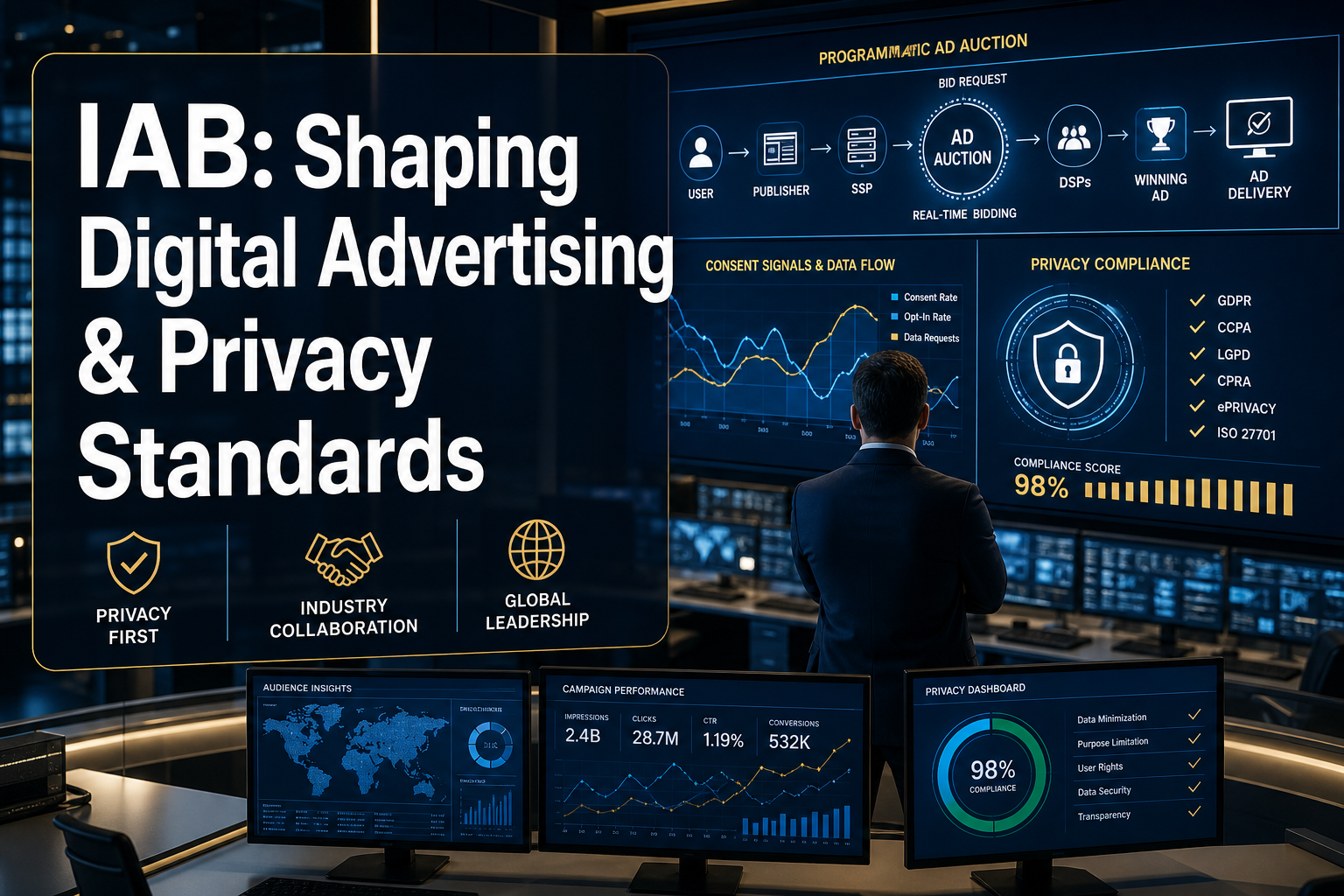
Quick Answer: The Interactive Advertising Bureau (IAB) is the principal trade organization governing digital advertising standards in the United States and, through its European affiliate, globally. It creates contractual frameworks, technical specifications, and policy guidelines that define how advertisers, publishers, ad tech vendors, and data processors handle targeting, measurement, and user privacy. In 2026, its most consequential work centers on the Multi-State Privacy Agreement (MSPA) and the technical standards maintained by IAB Tech Lab.
Key Takeaways
- The IAB functions as both a policy body and a de facto rule-setter for digital advertising contracts and technical standards.
- IAB Tech Lab is a separate but affiliated entity that produces the technical specifications (e.g., Global Privacy Platform, TCF) that operationalize IAB policy frameworks.
- On March 4, 2026, IAB announced the Fifth Amended and Restated MSPA, its most significant privacy contract update in years, effective June 2, 2026. [3][6]
- The MSPA standardizes how parties across the ad supply chain allocate responsibility for consumer rights requests, sensitive data handling, and state-specific opt-outs. [6]
- IAB membership costs vary by company revenue tier, ranging from a few thousand dollars annually for smaller firms to six-figure commitments for large enterprises.
- Publishers, advertisers, agencies, and ad tech vendors all have distinct compliance obligations under IAB standards.
- IAB standards are not legally binding regulations, but non-compliance creates contractual exposure and operational incompatibility with major platforms.
- The IAB's Transparency and Consent Framework (TCF) remains the dominant consent signaling standard in Europe under GDPR. [8]
What Does the IAB Do and Why Does It Matter
The IAB (Interactive Advertising Bureau) sets the technical, contractual, and policy standards that make programmatic digital advertising function at scale. Without a shared rulebook, every advertiser-publisher relationship would require bespoke contracts and incompatible technical integrations.
Founded in 1996, the IAB now represents over 700 member companies in the United States alone, including publishers, ad agencies, technology vendors, and data companies. Its guidelines cover everything from ad unit specifications and viewability measurement to consent management and privacy signal transmission [1]. The IAB matters because its standards have become the default infrastructure of digital advertising, not through regulatory mandate, but through industry adoption. Platforms, DSPs, and SSPs are built around IAB specifications, which means non-compliance is effectively self-exclusion from the ecosystem.
Why it matters for different stakeholders:
- Publishers: IAB standards determine how consent signals are collected and passed downstream, affecting ad revenue and legal exposure.
- Advertisers and agencies: The MSPA defines contractual liability allocation for privacy obligations across programmatic buys.
- Ad tech vendors: IAB Tech Lab specifications govern how consent, targeting, and measurement signals are encoded in bid requests.
- Data privacy professionals: IAB frameworks are the practical implementation layer for GDPR, CCPA, and state privacy law compliance.
How the IAB Created Standards for Digital Advertising
The IAB's standard-setting process is consensus-driven: working groups composed of member companies draft specifications, which then go through public comment periods before ratification. This approach gives standards legitimacy but also means they reflect the interests of large incumbents.
Key milestones in IAB standard-setting include the ad unit guidelines (standardizing banner and video formats), the OpenRTB protocol (enabling real-time bidding interoperability), and the Transparency and Consent Framework (TCF), which became the dominant GDPR consent mechanism in Europe [8]. The TCF 2.2 and subsequent versions define exactly how publishers must present consent choices and how that consent is encoded and transmitted to downstream vendors [5].
The role of the IAB in shaping digital advertising and privacy standards has evolved from format standardization toward privacy infrastructure, reflecting the regulatory environment of the last decade.
What Is the Difference Between IAB Tech Lab and the IAB Itself
The IAB and IAB Tech Lab are distinct organizations with complementary but separate mandates. The IAB is the trade association: it lobbies, publishes policy positions, manages membership, and produces contractual frameworks like the MSPA. IAB Tech Lab is the technical standards body: it builds and maintains the specifications that implement those frameworks in actual ad systems [2].
A useful analogy: the IAB writes the rulebook, and IAB Tech Lab builds the referee's tools. For example, the IAB's MSPA defines the legal and contractual obligations around consumer opt-outs. IAB Tech Lab's Global Privacy Platform (GPP) and US State Signals specifications define the technical format in which those opt-outs are encoded and transmitted across the programmatic supply chain [2].
Common confusion: Many practitioners assume "IAB standards" refers to a single body. In practice, compliance requires engaging with both the IAB's contractual layer (MSPA, membership agreements) and IAB Tech Lab's technical layer (GPP, TCF, OpenRTB extensions).
What Privacy Standards Has the IAB Implemented Recently
The most significant recent development is the Fifth Amended and Restated Multi-State Privacy Agreement (MSPA), announced March 4, 2026, and effective June 2, 2026 [3][6]. This update reflects the proliferation of state privacy laws since 2023 and restructures how the ad supply chain allocates compliance responsibilities.
The MSPA addresses:
- Definitions of "sale," "sharing," and targeted advertising under varying state law frameworks
- Allocation of responsibility for consumer rights requests (access, deletion, opt-out)
- Handling of sensitive data categories
- State-specific opt-out signal requirements [3]
On the technical side, IAB Tech Lab's Privacy Pillar includes the Global Privacy Platform (GPP), Global Privacy UI specifications, and US State Signals, all of which encode and transmit user privacy choices across ad systems [2]. The Data Deletion Request Framework (DDRF) v2 extends this infrastructure to handle downstream deletion obligations.
"The Fifth Amended and Restated MSPA is IAB's scalable solution to the advertiser privacy compliance dilemma, standardizing how parties allocate responsibilities for consumer rights requests and state-specific opt-outs in programmatic transactions.", IAB, 2026 [6]
How the IAB Handles GDPR and CCPA Compliance
The IAB does not enforce GDPR or CCPA directly, but it provides the contractual and technical infrastructure through which companies implement compliance. For GDPR, the IAB Europe Transparency and Consent Framework (TCF) is the primary mechanism: it standardizes how publishers obtain, record, and transmit consent to ad tech vendors operating under GDPR [8][10]. TCF 2.2 introduced stricter requirements around legitimate interest claims and vendor transparency.
For U.S. state laws including CCPA/CPRA, the MSPA serves as the contractual backbone, while IAB Tech Lab's US State Signals (part of the GPP) handle the technical encoding of opt-out preferences [2]. Publishers and advertisers who adopt both layers have a documented, standardized compliance posture that regulators and auditors can evaluate.
Important caveat: IAB frameworks are compliance tools, not legal guarantees. Whether a specific implementation satisfies a regulator's interpretation of GDPR or CCPA depends on how the framework is deployed and configured. Companies should work with legal counsel alongside adopting IAB standards.
What Companies Are Members of the IAB
IAB membership includes a broad cross-section of the digital advertising ecosystem. Major publishers (The New York Times, Condé Nast), large ad tech platforms, measurement companies, agencies, and data providers are all represented. The IAB does not publish a comprehensive real-time membership directory, but its working groups include household names across ad tech, media, and marketing.
Membership is tiered by company revenue, with annual dues ranging from approximately $2,500 for smaller companies to well over $100,000 for large enterprises (exact figures vary by tier and are confirmed through the IAB's membership portal). Members gain access to working groups, early access to draft standards, and the ability to influence specification development.
Who should join: Companies that operate at scale within programmatic advertising, need early visibility into evolving standards, or want a seat at the table in shaping compliance frameworks. Smaller publishers and advertisers can often implement IAB standards without membership, since the specifications themselves are publicly available [1].
Is the IAB Effective at Protecting User Privacy
The IAB's effectiveness on privacy is genuinely contested. Its frameworks provide a standardized, scalable mechanism for consent signaling and data handling, which is a real operational benefit. However, critics, including some data protection authorities, have argued that implementations of the TCF have not always met the bar required by GDPR, particularly around the validity of consent obtained through dark patterns or overly complex vendor lists [10].
The IAB's position is that it provides the infrastructure; compliance quality depends on how individual companies implement it. This is a reasonable distinction, but it also means the framework can be adopted in ways that satisfy the letter of the standard without fully protecting users.
For privacy professionals, the honest assessment is: IAB frameworks are necessary but not sufficient. They provide the signaling architecture, but the quality of consent UX, the accuracy of vendor lists, and the downstream enforcement of data processing agreements determine actual privacy outcomes.
What Is the IAB's Role in Third-Party Cookie Deprecation
The IAB and IAB Tech Lab have been central to the industry's response to third-party cookie deprecation. IAB Tech Lab's Addressability and Privacy-Enhancing Technologies (PETs) standards portfolio addresses the technical gap left by cookie loss, covering topics such as first-party data clean rooms, contextual targeting signals, and privacy-preserving measurement approaches [7].
The role of the IAB in shaping digital advertising and privacy standards in the post-cookie era involves coordinating industry alignment around alternative identity solutions and ensuring that new technical approaches (such as browser-based APIs or cohort-based targeting) are interoperable across the ecosystem.
Practical implication: Publishers and advertisers who rely on IAB Tech Lab's addressability standards will have a more interoperable path to post-cookie measurement and targeting than those building proprietary solutions in isolation.
Common Mistakes Advertisers Make With IAB Standards
Understanding where practitioners go wrong helps avoid costly compliance gaps.
- Treating the MSPA as a checkbox, not a contract: The MSPA requires operational changes, not just a signature. Advertisers must update their data processing flows, consumer rights request handling, and vendor agreements to reflect the Fifth Amended version by June 2, 2026 [6].
- Conflating IAB and IAB Tech Lab: Signing onto the MSPA does not automatically mean your systems implement GPP signals correctly. Both layers require independent attention.
- Assuming TCF consent covers U.S. obligations: TCF is a GDPR tool. U.S. state law compliance requires the MSPA and US State Signals separately [2][3].
- Ignoring vendor list hygiene: TCF implementations with outdated or inflated vendor lists create both legal exposure and user experience problems [10].
- Not updating CMP configurations: Consent Management Platforms must be configured to reflect current IAB TCF and GPP specifications. Tools like Biscotti CMP are designed to support IAB-compliant consent collection and signal transmission, but configuration quality determines compliance outcomes.
Who Should Care About IAB Guidelines and Who Shouldn't
IAB guidelines are directly relevant to any company that participates in programmatic advertising, operates a publisher monetized by display or video ads, or processes user data in the context of digital advertising. This includes DSPs, SSPs, DMPs, publishers, agencies, and brand advertisers.
Companies that do not run programmatic advertising, do not use behavioral targeting, and do not participate in the digital ad supply chain have limited direct exposure to IAB standards. A small e-commerce site running only Google Ads with basic consent management, for example, may not need to engage with the MSPA directly, though it will still interact with IAB-derived consent signals through its ad platform.
Decision rule: If your business touches programmatic buying, selling, or measurement at any scale, IAB standards are operationally relevant. If you only use walled-garden platforms with self-contained consent mechanisms, your exposure is indirect but still present through platform policies that themselves reflect IAB frameworks.
How to Comply With IAB Standards as a Publisher
Publisher compliance with IAB standards involves several distinct workstreams.
- Implement a TCF-compliant CMP for European traffic, ensuring your consent UI meets TCF 2.2 requirements and your vendor list is current [8].
- Adopt GPP and US State Signals for U.S. state law compliance, encoding opt-out preferences in the standardized format that downstream ad systems can read [2].
- Review and execute the MSPA (Fifth Amended version, effective June 2, 2026) with your demand partners, ensuring contractual alignment on privacy obligations [3][6].
- Audit your ad stack to confirm that SSPs and ad servers you work with support current IAB Tech Lab specifications for consent signal passing.
- Maintain vendor list accuracy in your CMP configuration, removing vendors that are no longer active or relevant.
Publishers using a consent management platform should verify that their chosen tool supports the current versions of both TCF and GPP. Biscotti CMP supports IAB-compliant consent workflows and is worth evaluating as part of a publisher's compliance stack.
What Alternatives Exist to IAB Standards for Ad Tech
IAB standards dominate the programmatic ecosystem, but alternatives exist in specific contexts.
- Google's Privacy Sandbox APIs offer browser-native alternatives for interest-based advertising and measurement that do not rely on IAB consent frameworks, though they intersect with IAB Tech Lab's work on PETs [7].
- Contextual advertising platforms bypass behavioral targeting entirely, reducing (though not eliminating) the need for IAB consent infrastructure.
- Walled gardens (Google, Meta, Amazon) operate largely within their own consent and data governance frameworks, though they increasingly align with IAB signals for interoperability.
- Regional frameworks such as the IAB Europe TCF have no direct competitors at scale for GDPR consent signaling, though some publishers have attempted proprietary consent flows with mixed regulatory reception [10].
For most publishers and advertisers operating in open programmatic markets, IAB standards are the practical default. Alternatives are viable for specific use cases but rarely replace IAB frameworks at the ecosystem level.
FAQ
What is the IAB's primary function? The IAB is a trade association that sets standards, publishes guidelines, and creates contractual frameworks for the digital advertising industry. It represents publishers, advertisers, agencies, and ad tech companies.
Is IAB membership required to use IAB standards? No. IAB technical standards and most guidelines are publicly available. Membership provides influence over standard development and early access to drafts, but is not required for implementation.
What is the MSPA and why does it matter in 2026? The Multi-State Privacy Agreement is a standardized contract framework that allocates privacy compliance responsibilities across the digital ad supply chain under U.S. state privacy laws. The Fifth Amended version took effect June 2, 2026, and is the current operative version for U.S. programmatic transactions [3][6].
What is the difference between the TCF and the GPP? The Transparency and Consent Framework (TCF) is a GDPR-focused consent signaling standard used primarily in Europe [8]. The Global Privacy Platform (GPP) is a broader IAB Tech Lab standard that encodes privacy signals across multiple jurisdictions, including U.S. state laws [2].
Does using a CMP automatically make a publisher IAB-compliant? Not automatically. A CMP must be correctly configured to reflect current IAB TCF and GPP specifications, with an accurate vendor list and a compliant consent UI. The tool provides the infrastructure; configuration determines compliance quality.
How often does the IAB update its standards? Major framework updates occur every one to three years, with incremental updates more frequently. The MSPA has seen five major amendments since its introduction, with the most recent in 2026 [3].
What is IAB Tech Lab's Privacy Pillar? It is the organizational unit within IAB Tech Lab responsible for privacy-related technical standards, including the GPP, US State Signals, Global Privacy UI specs, and the Data Deletion Request Framework [2].
Are IAB standards legally binding? No. They are industry standards and contractual frameworks. Legal obligations arise from the underlying regulations (GDPR, CCPA, etc.) and from contracts that incorporate IAB frameworks, not from IAB membership or adoption itself.
What happens if a company ignores IAB standards? Practical consequences include incompatibility with major programmatic platforms, inability to pass consent signals correctly, contractual exposure under the MSPA, and potential regulatory scrutiny if consent collection does not meet legal requirements.
Who enforces the MSPA? The MSPA is a contractual framework enforced through private contract law between signatories. Regulatory enforcement of the underlying privacy obligations comes from state attorneys general and data protection authorities, not the IAB.
Conclusion
The role of the IAB in shaping digital advertising and privacy standards has shifted from format governance to privacy infrastructure over the past decade, and that shift accelerated sharply in 2026 with the Fifth Amended MSPA. For practitioners across the digital advertising ecosystem, the actionable priorities are clear.
Next steps by role:
- Publishers: Verify your CMP supports current TCF 2.2 and GPP specifications, and confirm your demand partners have executed the updated MSPA. Evaluate tools like Biscotti CMP for IAB-aligned consent management.
- Advertisers and agencies: Audit your programmatic contracts against the Fifth Amended MSPA requirements and update operational flows for consumer rights request handling before or immediately after the June 2, 2026 effective date [6].
- Ad tech vendors: Ensure your platforms encode and transmit US State Signals and GPP strings correctly, and review IAB Tech Lab's addressability standards for post-cookie readiness [7].
- Data privacy professionals: Use IAB frameworks as the operational layer for GDPR and state law compliance, but pair them with legal review to ensure implementation quality meets regulatory expectations.
IAB standards are not optional for companies operating at scale in programmatic advertising. Treating them as a compliance checkbox rather than an operational foundation is the most common and costly mistake in the ecosystem.
References
[1] Guidelines - https://www.iab.com/guidelines/ [2] Privacy - https://iabtechlab.com/standards/privacy/ [3] IAB Announces Updates to Multi-State Privacy Agreement - https://www.iab.com/news/iab-announces-updates-to-multi-state-privacy-agreement/ [4] IAB Tech Lab Expands Global Privacy Frameworks With GPP Updates And DDRF V2 Release - https://www.prnewswire.com/news-releases/iab-tech-lab-expands-global-privacy-frameworks-with-gpp-updates-and-ddrf-v2-release-302592077.html [5] IAB TCF 2.3 Transparency and Consent Framework Quick Guide - https://usercentrics.com/knowledge-hub/iab-tcf-2-3-transparency-and-consent-framework-quick-guide/ [6] Advertiser Privacy Compliance Solution Arrives - https://www.iab.com/blog/advertiser-privacy-compliance-solution-arrives/ [7] Addressability and PETs - https://iabtechlab.com/standards/addressability-and-pets/ [8] Transparency Consent Framework - https://iabeurope.eu/transparency-consent-framework/ [9] IAB State of Data 2024 - https://www.iab.com/wp-content/uploads/2024/03/IAB-State-of-Data-2024.pdf [10] IAB Europe Transparency Consent Framework Policies - https://iabeurope.eu/iab-europe-transparency-consent-framework-policies/