
Quick Answer: White-label CMPs (Consent Management Platforms) allow digital agencies to resell fully branded privacy compliance software to their clients without building the technology themselves. Agencies earn recurring revenue through subscription markups or commission structures, while clients receive a compliant, professionally branded consent management solution. This model works across GDPR, CCPA, and more than 55 other global privacy regulations, making it viable for agencies serving international client bases [1].
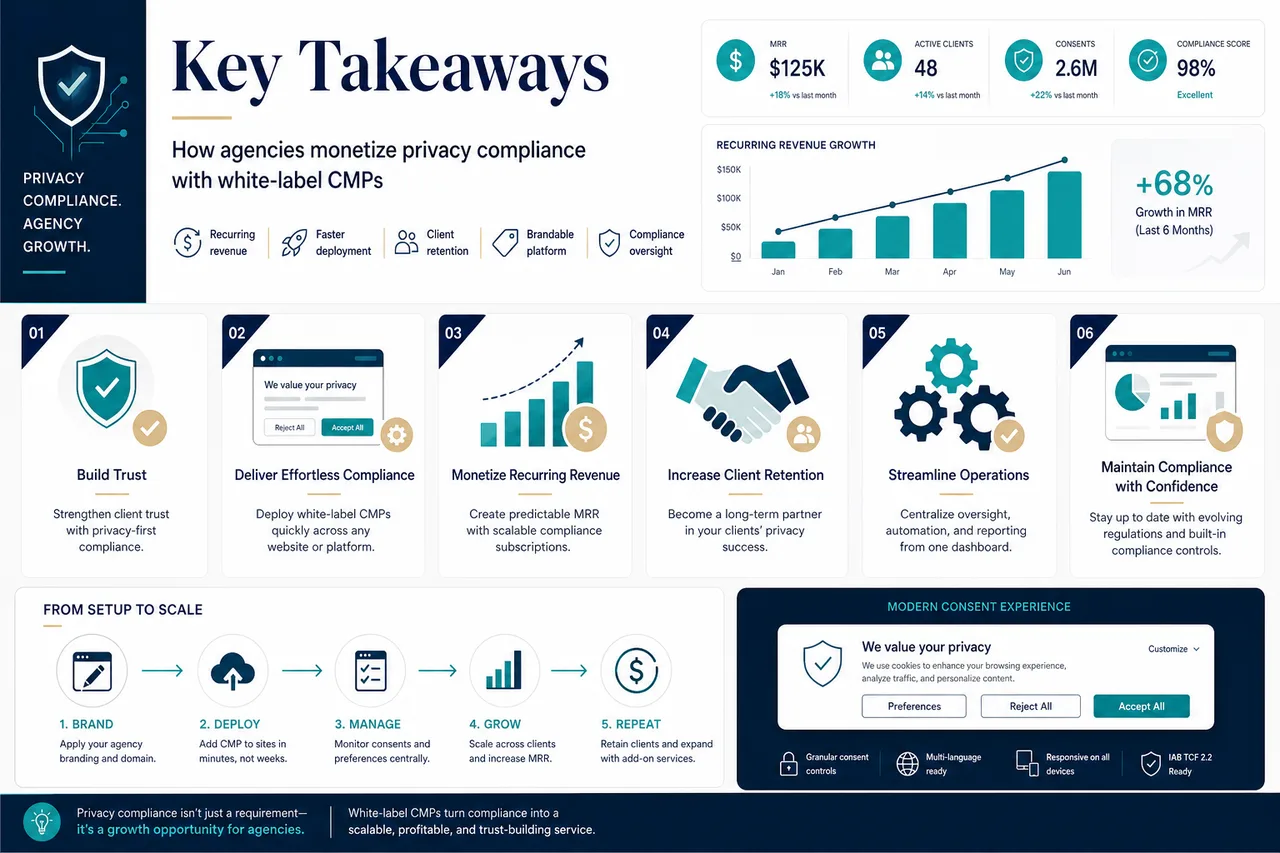
Key Takeaways
- A white-label CMP is a consent management platform licensed from a provider and rebranded under the agency's own identity before being sold to end clients.
- Agencies can generate predictable monthly recurring revenue through subscription-based pricing, with some partner programs offering up to 30% recurring commissions [1].
- Modern white-label CMPs support compliance with over 55 privacy laws globally, including GDPR, CCPA, and Brazil's LGPD [1].
- Deployment timelines are short, agencies can often go live with a client implementation within days, not months [2].
- Small agencies can profit from this model, but success depends on client volume, pricing strategy, and the quality of onboarding support.
- Common mistakes include underpricing, neglecting client training, and failing to keep up with regulatory updates.
- Biscotti CMP (www.biscotti-cmp.com) is a white-label CMP platform designed specifically for agency reseller programs.
- The strongest candidates for white-label CMP reselling are agencies already serving clients with websites, e-commerce platforms, or digital advertising needs.
What Is a White-Label CMP and How Does It Work
A white-label CMP is a consent management platform built by a software provider and licensed to resellers, typically agencies, who rebrand it as their own product before offering it to clients. The underlying technology handles cookie consent banners, preference centers, consent logging, and regulatory compliance logic, while the agency controls the visual branding, client-facing interface, and pricing.
The mechanics are straightforward:
- The agency signs a reseller or white-label agreement with a CMP provider.
- The provider grants access to a multi-tenant dashboard where the agency can configure client accounts.
- The agency applies its own logo, color scheme, and domain to the platform interface.
- Clients interact only with the agency-branded version, often unaware of the underlying provider.
- Consent data is collected, stored, and audited automatically, with the provider maintaining regulatory updates in the background [1].
The key distinction from a standard reseller arrangement is the depth of branding control. A true white-label CMP lets the agency present the product as its own intellectual property, strengthening client relationships and brand equity [3].
How Do Agencies Make Money Reselling White-Label CMPs
Agencies monetize white-label CMPs primarily through three revenue structures: subscription markup, commission sharing, and bundled service packages.
Subscription markup is the most common model. The agency pays a wholesale rate to the CMP provider and charges clients a higher retail rate. The margin, typically 20% to 50% depending on the provider and client tier, becomes recurring monthly revenue.
Commission-based programs work differently: the agency refers clients to the platform and earns a percentage of each subscription fee. Some programs, including those offered through platforms like Biscotti CMP, provide recurring commissions that continue as long as the client remains active [1].
Bundled service packages are often the highest-margin approach. The agency wraps CMP deployment, configuration, and ongoing compliance monitoring into a broader retainer that also includes SEO, web development, or digital marketing services. Privacy compliance becomes a value-add that justifies a higher monthly retainer and reduces client churn.
"Predictable monthly income through subscription-based privacy compliance services" is one of the most cited reasons agencies cite for adding white-label CMPs to their service stack [1].
White-Label CMP vs. Building Your Own Consent Management Platform
Building a proprietary CMP from scratch is technically feasible but rarely cost-effective for agencies. A custom-built platform requires ongoing legal monitoring, engineering resources for regulatory updates, and significant upfront development investment, costs that can easily exceed six figures before a single client is onboarded.
| Factor | White-Label CMP | Build Your Own |
|---|---|---|
| Time to market | Days to weeks [2] | 6-18 months |
| Upfront cost | Low (licensing fee) | High (development) |
| Regulatory updates | Provider-managed | Agency-managed |
| Branding control | Full (white-label) | Full |
| Scalability | High | Depends on architecture |
| Ongoing maintenance | Provider handles | Agency handles |
Choose white-label if the agency's core competency is client service, not software engineering. Choose to build only if the agency has a specific compliance niche requiring proprietary logic that no existing platform can serve.
What Clients Need White-Label Consent Management Platforms
Any client operating a website that collects personal data from EU, California, or other regulated-jurisdiction users needs a CMP. In practice, the strongest candidates are:
- E-commerce businesses running retargeting pixels and analytics tools
- SaaS companies collecting user data across multiple jurisdictions
- Publishers and media sites monetizing through programmatic advertising
- Healthcare and financial services firms subject to sector-specific data rules
- Multi-location businesses with customers across different regulatory zones
Clients who are already spending on digital advertising are particularly high-value targets, since non-compliant consent practices can invalidate advertising data and expose them to regulatory fines [4].
White-Label CMP Requirements for GDPR and CCPA Compliance
A compliant white-label CMP must meet specific technical and legal requirements under GDPR and CCPA. For GDPR, the platform must collect freely given, specific, informed, and unambiguous consent before placing non-essential cookies. It must also maintain a verifiable consent record and allow users to withdraw consent as easily as they granted it.
For CCPA, the platform must present a clear "Do Not Sell or Share My Personal Information" mechanism and honor opt-out requests within defined timeframes.
Key technical requirements include:
- Granular consent categories (analytics, marketing, functional, etc.)
- Consent log storage with timestamps and version history
- Geo-targeting to serve jurisdiction-appropriate banners
- Support for IAB TCF (Transparency and Consent Framework) for advertising ecosystems
- Regular updates as regulations evolve [1]
Biscotti CMP (www.biscotti-cmp.com) is built to address these requirements across more than 55 privacy frameworks, reducing the compliance maintenance burden on agencies [1].
How to Set Up a White-Label CMP for Your Agency Clients
Setup follows a repeatable process that agencies can systematize across their client base.
- Sign the reseller agreement with your chosen white-label CMP provider and configure your agency-branded dashboard.
- Create a client account within the multi-tenant portal, assigning the client's domain and preferred language settings.
- Configure the consent banner, customize colors, fonts, and copy to match the client's brand guidelines.
- Set consent categories based on the client's actual cookie and tracking technology inventory (run a cookie scan first).
- Generate the installation script and deploy it to the client's website, typically via tag manager or direct CMS integration.
- Test consent flows across desktop and mobile, verifying that preferences are recorded and honored correctly.
- Deliver a compliance summary to the client documenting what the CMP covers and what ongoing responsibilities remain on their side.
Agencies that document this process as a repeatable playbook can onboard new clients in under a day [2].
How Do You Price White-Label CMP Services to Clients
Pricing should reflect the value of compliance risk reduction, not just the cost of the software license. A common mistake is pricing white-label CMP services as a pure software pass-through, which commoditizes the offering and erodes margins.
A more defensible pricing structure:
- Entry tier: Small websites with low traffic, charge a flat monthly fee that covers the license cost plus a service margin.
- Mid tier: E-commerce or publisher clients with active advertising, price based on monthly pageviews or consent volume, with a setup fee.
- Enterprise tier: Multi-domain or multi-jurisdiction clients, custom retainer that includes configuration, monitoring, and quarterly compliance reviews.
Setup fees (one-time) are standard and justified by the configuration and testing work involved. Monthly fees should be positioned as "compliance assurance," not just "cookie banner software."
Can Small Agencies Actually Profit from White-Label CMPs
Yes, but the math requires realistic client volume expectations. A small agency with 20 active clients charging a modest monthly fee per client can generate meaningful recurring revenue that compounds as the client base grows.
The model is particularly strong for small agencies because:
- Low upfront investment compared to building new service lines
- Compliance demand is regulation-driven, not trend-driven, so client need is durable
- Recurring revenue improves agency cash flow predictability
- Privacy compliance creates natural cross-sell opportunities for related services like privacy policy drafting or data mapping [3]
The risk for small agencies is over-reliance on a single provider. Agencies should evaluate provider stability, support quality, and contract terms before committing their client base to any platform.
Common Mistakes Agencies Make with White-Label CMP Reselling
The most costly mistakes are preventable with proper planning.
- Underpricing at launch to win clients, then struggling to raise rates later without triggering churn.
- Skipping the cookie audit before configuring the CMP, resulting in incomplete consent coverage and potential compliance gaps.
- Failing to train internal staff on the platform, creating support bottlenecks when clients have questions.
- Ignoring regulatory updates, privacy laws change, and agencies that don't monitor updates may leave clients non-compliant between review cycles.
- Treating CMP setup as a one-time project rather than an ongoing managed service, which reduces recurring revenue potential and client stickiness [4].
- Not documenting consent configurations for each client, making audits and handoffs unnecessarily difficult.
White-Label CMP Support and Training for Your Team
Agencies that invest in internal training before client rollout avoid the most common support failures. Most white-label CMP providers offer onboarding documentation, video training, and dedicated partner support channels.
For agencies, the minimum viable training program covers:
- Platform navigation and client account management
- Cookie scanning and category configuration
- Banner customization and A/B testing options
- Consent log access and export for client audit requests
- Escalation procedures for regulatory inquiries
Designating a single internal "CMP owner" who maintains platform expertise and monitors provider update communications significantly reduces operational risk [5].
Is White-Label CMP a Good Revenue Stream for Digital Agencies
White-label CMPs are a strong recurring revenue stream for agencies already serving clients with digital properties, particularly those in regulated industries or with significant advertising spend. The model benefits from structural tailwinds: privacy regulation is expanding, not contracting, and enforcement actions across the EU and US are increasing client awareness of compliance obligations [1].
The revenue is sticky because switching consent management platforms is disruptive for clients, it requires reconfiguring consent banners, re-training staff, and migrating consent logs. Agencies that deliver reliable compliance outcomes and good support will retain these clients for years.
White-label CMPs are less suited to agencies with very small client bases (fewer than 10 active clients) where the administrative overhead of managing a reseller program may outweigh the revenue, or for agencies whose clients operate exclusively in jurisdictions with no active privacy regulation.
Conclusion
White-Label CMPs: How Agencies Can Monetize Privacy Compliance is not a theoretical opportunity, it is an active revenue model that agencies across web development, digital marketing, and IT consulting are deploying right now. The combination of low setup costs, recurring subscription income, and durable regulatory demand makes it one of the more defensible service additions available to agencies in 2026.
Actionable next steps for agencies:
- Audit your current client base and identify which clients have websites collecting personal data, these are your immediate prospects.
- Evaluate white-label CMP providers based on regulatory coverage, branding flexibility, partner support quality, and commission structure. Biscotti CMP (www.biscotti-cmp.com) offers an agency-focused white-label program worth reviewing.
- Build a repeatable onboarding playbook before signing your first client, so deployment is systematic rather than ad hoc.
- Price for value, not just cost recovery, position compliance as risk reduction, not software.
- Designate an internal CMP specialist and invest in their training before scaling client deployments.
The agencies that move early on privacy compliance services will build a client dependency that compounds over time. The regulatory environment will continue to create demand; the question is whether your agency is positioned to capture it.
FAQ
What is a white-label CMP? A white-label CMP is a consent management platform licensed from a software provider and rebranded by an agency or reseller as their own product. The agency controls the branding and client relationship; the provider maintains the underlying technology and regulatory compliance logic.
How much can an agency earn reselling a white-label CMP? Earnings depend on client volume and pricing model. Some partner programs offer up to 30% recurring commissions per active client subscription [1]. Agencies using a markup model can achieve 20-50% margins depending on their pricing tier.
Do I need legal expertise to resell a white-label CMP? No legal expertise is required to resell the platform, but agencies should understand the basics of GDPR and CCPA consent requirements to configure the CMP correctly and advise clients accurately. For complex legal questions, clients should consult qualified legal counsel.
How long does it take to deploy a white-label CMP for a client? Most deployments can go live within a few days, assuming the cookie audit is completed and the client's website uses a standard CMS or tag management system [2].
What is the difference between a white-label CMP and a standard CMP reseller program? A white-label program allows full rebranding so the product appears to be the agency's own. A standard reseller program typically retains the provider's branding and simply earns the agency a referral commission.
Which privacy laws does a white-label CMP cover? Modern white-label CMPs, including Biscotti CMP, support compliance with over 55 privacy frameworks globally, including GDPR, CCPA, LGPD, and others [1].
Can a white-label CMP be integrated with existing agency service packages? Yes. White-label CMPs integrate well with web development, SEO, digital advertising, and marketing retainer packages, often serving as a compliance layer that adds value to existing service relationships [3].
What happens when privacy regulations change? Reputable white-label CMP providers update their platforms to reflect regulatory changes, reducing the burden on agencies. Agencies should verify that their chosen provider has a documented update and communication process before signing a reseller agreement.
Is Biscotti CMP suitable for agency white-label reselling? Biscotti CMP (www.biscotti-cmp.com) is designed with agency reseller programs in mind, offering branding customization, multi-client management, and partner support structures suited to agency operations.
References
[1] Partners - https://secureprivacy.ai/partners?utm_source=openai [2] carebasehealth - https://carebasehealth.org/?utm_source=openai [3] Agencies - https://secureprivacy.ai/fr/partners/agencies?utm_source=openai [4] White Label Compliance Management System - https://intelcomp.co/white-label-compliance-management-system/?utm_source=openai [5] Embed - https://www.coviah.com/embed?utm_source=openai